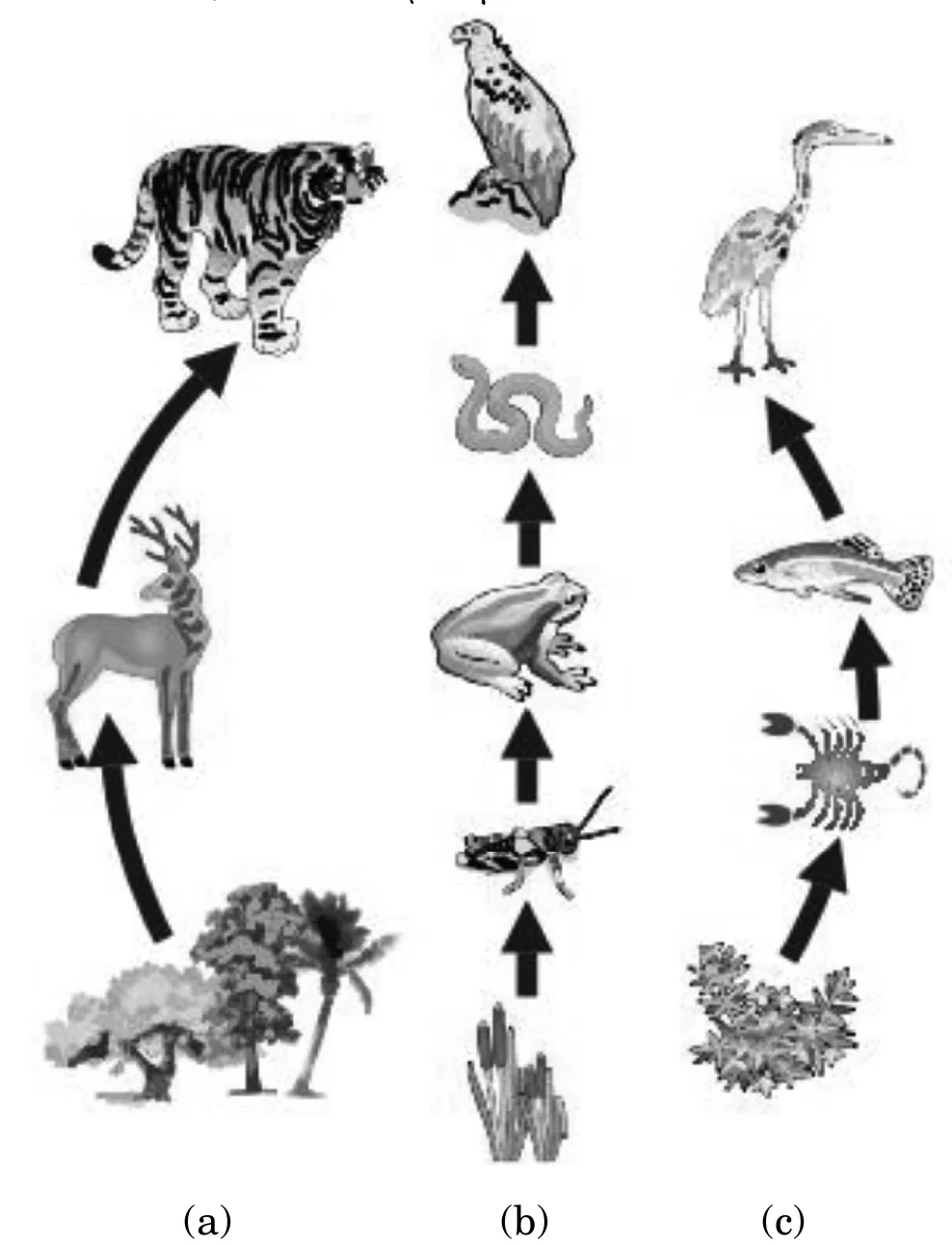
Study the picture given below showing three food chains (a), (b) and (c) and answer the following questions: (i) Name the type of ecosystems that exist in food chains (b) and (c). (ii) The first trophic level in all food chains are producers. Why? What percentage of solar energy do these producers capture for their use? (iii) Why are the arrows shown in the diagram in one direction only and not vice versa? Justify.
Study the picture given below showing three food chains (a), (b) and (c) and answer the following questions: (i) Name the type of ecosystems that exist in food chains (b) and (c). (ii) The first trophic level in all food chains are producers. Why? What percentage of solar energy do these producers capture for their use? (iii) Why are the arrows shown in the diagram in one direction only and not vice versa? Justify.
Official answer
The type of ecosystems that exist in food chains (b) and (c) are aquatic ecosystems. The first trophic level in all food chains are producers because they capture solar energy and convert it into chemical energy through photosynthesis. Producers capture about 1% of the solar energy that falls on their leaves. The arrows shown in the diagram are in one direction only because energy flows from one trophic level to the next, but not vice versa. This is because energy is lost at each trophic level, and it cannot be transferred back to the previous level.
Marking scheme
- 1.Type of ecosystems
- 2.Role of producers
- 3.Percentage of solar energy captured
- 4.Direction of energy flow
Hint
The type of ecosystems that exist in food chains (b) and (c) are aquatic ecosystems. The first trophic level in all food chains are producers because they capture solar energy and convert it into chemical energy through photosynthesis. Producers capture about 1% of the solar energy that falls on their leaves. The arrows shown in the diagram are in one direction only because energy flows from one trophic level to the next, but not vice versa. This is because energy is lost at each trophic level, and it cannot be transferred back to the previous level.
Quick oral answer
The type of ecosystems that exist in food chains (b) and (c) are aquatic ecosystems. The first trophic level in all food chains are producers because they capture solar energy and convert it into chemical energy through photosynthesis. Producers capture about 1% of the solar energy that falls on their leaves. The arrows shown in the diagram are in one direction only because energy flows from one trophic level to the next, but not vice versa. This is because energy is lost at each trophic level, and it cannot be transferred back to the previous level.
Common mistakes
- 1.confusing the type of ecosystems
- 2.not understanding the role of producers
- 3.not knowing the percentage of solar energy captured
- 4.not understanding the direction of energy flow
Analysis and explanation
The question requires the student to analyze the food chains and identify the type of ecosystems that exist in them. It also requires the student to understand the role of producers in the food chain and the percentage of solar energy they capture. Finally, it requires the student to understand the direction of energy flow in the food chain and why it is unidirectional.
Interesting facts
Aquatic ecosystems are found in freshwater and marine environments.
Producers are the primary source of energy for all living organisms.
The percentage of solar energy captured by producers varies depending on the type of ecosystem.
Question details
Q33 of 39 questions
- Board
- CBSE
- Class
- Class 10
- Subject
- Science
- Year
- 2024
- Section
- Section C
- Marks
- 3
- Type
- Short Answer
- Chapter
- Our Environment
- Topic
- Ecosystems and Food Chains
- Bloom's level
- Understanding
- Syllabus topic
- Ecosystems and Food Chains
Spotted a mistake or something unclear?
Tell us and we will fix it.
Frequently asked questions
How many marks does this question carry in CBSE Class 10 Science 2024?
This question carries 3 marks in the CBSE Class 10 Science 2024 examination.
Which chapter does this question come from in Science?
This question is from the chapter "Our Environment" in the CBSE Class 10 Science syllabus.
What topic does this question cover in Science?
This question covers the topic "Ecosystems and Food Chains" from CBSE Class 10 Science.
What type of question is this in the CBSE Class 10 Science 2024 paper?
This is a Short Answer question from Section C in the CBSE Class 10 Science 2024 paper.