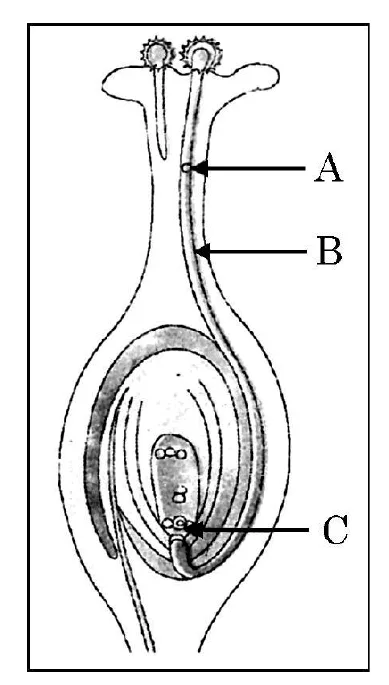
(a) (i) What are spores? On which structures are they formed? How do they overcome unfavourable conditions? Name the organism which multiplies with the help of these structures. (ii) Give two reasons why some plants are grown by the method of vegetative propagation. List two methods used to grow plants vegetatively. OR (b) (i) Study the diagram given below and name the parts marked as A, B and C. What happens when B reaches C in the ovary? Mention its significance. (ii) Write the post fertilisation changes that occur in a flower.
(a) (i) What are spores? On which structures are they formed? How do they overcome unfavourable conditions? Name the organism which multiplies with the help of these structures. (ii) Give two reasons why some plants are grown by the method of vegetative propagation. List two methods used to grow plants vegetatively. OR (b) (i) Study the diagram given below and name the parts marked as A, B and C. What happens when B reaches C in the ovary? Mention its significance. (ii) Write the post fertilisation changes that occur in a flower.
Official answer
(b) (i) A - stigma, B - pollen tube, C - ovary. When B reaches C in the ovary, fertilization occurs. This is significant because it leads to the formation of a zygote and eventually a new individual. (ii) Post-fertilization changes that occur in a flower include the development of the embryo, endosperm, and fruit.
Marking scheme
- 1.(i) Spores are reproductive structures formed on specialized structures called sporangia. They help organisms overcome unfavorable conditions by allowing them to survive in a dormant state until conditions become favorable again. The organism that multiplies with the help of these structures is a fern.
- 2.(ii) Two reasons why some plants are grown by the method of vegetative propagation are: 1) It allows for the rapid production of new plants, and 2) it ensures that the new plants will have the same desirable traits as the parent plant. Two methods used to grow plants vegetatively are: 1) layering, and 2) grafting.
Hint
To answer this question, focus on the process of reproduction in organisms and the significance of fertilization. Identify the different parts of a flower and their functions, and explain the post-fertilization changes that occur in a flower.
Quick oral answer
The process of reproduction in organisms involves the formation of gametes, fertilization, and the development of a new individual. In plants, reproduction can occur through sexual or asexual means, including vegetative propagation. The diagram shows the structure of a flower, with the stigma, pollen tube, and ovary labeled. When the pollen tube reaches the ovary, fertilization occurs, resulting in the formation of a zygote and eventually a new individual. This process is significant because it allows for the continuation of the species. In addition to fertilization, post-fertilization changes also occur in a flower, including the development of the embryo, endosperm, and fruit. These changes are important for the growth and development of the new individual.
Common mistakes
- 1.confusing the terms 'spore' and 'seed'
- 2.not understanding the significance of fertilization
Analysis and explanation
This question requires the student to understand the process of reproduction in organisms and the significance of fertilization. It also requires the student to identify the different parts of a flower and their functions. The correct answer is option b, which provides a clear and concise explanation of the process of reproduction in organisms and the significance of fertilization.
Interesting facts
Some plants can produce multiple generations in a single growing season through vegetative propagation.
Vegetative propagation is used in agriculture to produce large quantities of genetically identical plants.
Question details
Q35 of 39 questions
- Board
- CBSE
- Class
- Class 10
- Subject
- Science
- Year
- 2024
- Section
- Section D
- Marks
- 5
- Type
- Long Answer
- Chapter
- How do Organisms Reproduce?
- Topic
- Reproduction in Organisms
- Bloom's level
- Understanding
- Syllabus topic
- Reproduction in Organisms
Spotted a mistake or something unclear?
Tell us and we will fix it.
Frequently asked questions
How many marks does this question carry in CBSE Class 10 Science 2024?
This question carries 5 marks in the CBSE Class 10 Science 2024 examination.
Which chapter does this question come from in Science?
This question is from the chapter "How do Organisms Reproduce?" in the CBSE Class 10 Science syllabus.
What topic does this question cover in Science?
This question covers the topic "Reproduction in Organisms" from CBSE Class 10 Science.
What type of question is this in the CBSE Class 10 Science 2024 paper?
This is a Long Answer question from Section D in the CBSE Class 10 Science 2024 paper.