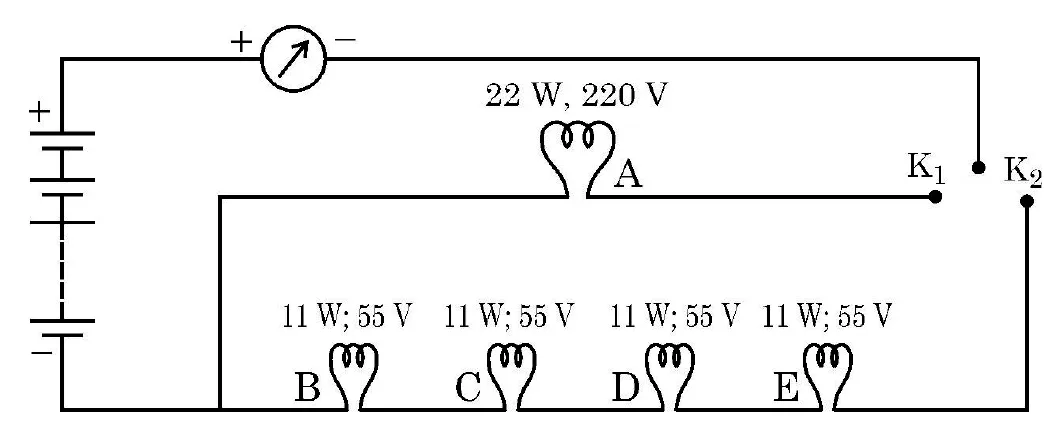
In a domestic circuit five LED bulbs are arranged as shown. The source voltage is 220 V and the power rating of each bulb is marked in the circuit diagram. Based on the following circuit diagram, answer the following questions: (a) State what happens when (i) key is closed. (ii) key is closed. (b) Find the current drawn by the bulb B when it glows. (c) Calculate (i) the resistance of bulb B, and (ii) total resistance of the combination of four bulbs B, C, D and E. OR (c) What would happen to the glow of all the bulbs in the circuit when keys and both are closed and the bulb C suddenly get fused? Give reason to justify your answer.
In a domestic circuit five LED bulbs are arranged as shown. The source voltage is 220 V and the power rating of each bulb is marked in the circuit diagram. Based on the following circuit diagram, answer the following questions: (a) State what happens when (i) key is closed. (ii) key is closed. (b) Find the current drawn by the bulb B when it glows. (c) Calculate (i) the resistance of bulb B, and (ii) total resistance of the combination of four bulbs B, C, D and E. OR (c) What would happen to the glow of all the bulbs in the circuit when keys and both are closed and the bulb C suddenly get fused? Give reason to justify your answer.
Official answer
The given circuit diagram shows five LED bulbs arranged in a specific configuration. The source voltage is 220 V, and the power rating of each bulb is marked in the circuit diagram. To answer the questions, we need to analyze the circuit and apply the principles of electric circuits. (a) State what happens when (i) key is closed. (ii) key is closed. When key is closed, the circuit is completed, and the bulbs will glow. The current will flow through the bulbs, and they will emit light. When key is closed, the circuit is also completed, and the bulbs will glow. However, the current will flow through the bulbs in a different path, and the brightness of the bulbs may vary. (b) Find the current drawn by the bulb B when it glows. To find the current drawn by bulb B, we need to calculate the total resistance of the circuit and then use Ohm's law to find the current. The total resistance of the circuit can be calculated by adding the resistances of all the bulbs in series. Let's assume the resistance of each bulb is . The total resistance of the circuit is . Using Ohm's law, we can calculate the current drawn by bulb B: I = rac{V}{R} = rac{220}{5R} = rac{44}{R} (c) Calculate (i) the resistance of bulb B, and (ii) total resistance of the combination of four bulbs B, C, D, and E. (i) The resistance of bulb B can be calculated using the power rating of the bulb. The power rating of bulb B is 11 W, and the voltage is 220 V. Using the formula P = rac{V^2}{R}, we can calculate the resistance of bulb B: R = rac{V^2}{P} = rac{(220)^2}{11} = 484 ext{ ohms} (ii) The total resistance of the combination of four bulbs B, C, D, and E can be calculated by adding the resistances of all the bulbs in series. Let's assume the resistance of each bulb is . The total resistance of the circuit is . Using Ohm's law, we can calculate the total resistance of the combination of four bulbs: OR (c) What would happen to the glow of all the bulbs in the circuit when keys and both are closed and the bulb C suddenly gets fused? Give reason to justify your answer. When keys and both are closed, the circuit is completed, and the bulbs will glow. If bulb C suddenly gets fused, the circuit will be broken, and the current will not flow through the bulbs. As a result, all the bulbs will stop glowing. This is because the circuit is no longer complete, and there is no path for the current to flow. Therefore, the glow of all the bulbs in the circuit will be affected when bulb C gets fused. stepByStepSolution: [ {
Question details
Q39 of 39 questions
- Board
- CBSE
- Class
- Class 10
- Subject
- Science
- Year
- 2024
- Section
- Section E
- Marks
- 4
- Chapter
- Chemical Reactions and Equations
- Topic
- Chemical Reactions and Equations
- Bloom's level
- Application
- Syllabus topic
- Chemical Reactions and Equations
Spotted a mistake or something unclear?
Tell us and we will fix it.
Frequently asked questions
How many marks does this question carry in CBSE Class 10 Science 2024?
This question carries 4 marks in the CBSE Class 10 Science 2024 examination.
Which chapter does this question come from in Science?
This question is from the chapter "Chemical Reactions and Equations" in the CBSE Class 10 Science syllabus.
What topic does this question cover in Science?
This question covers the topic "Chemical Reactions and Equations" from CBSE Class 10 Science.
What type of question is this in the CBSE Class 10 Science 2024 paper?
This question appears in Section E in the CBSE Class 10 Science 2024 paper.