Use Ohm's law to determine the potential difference across the resistor in the circuit shown in the following diagram when key is closed:
Use Ohm's law to determine the potential difference across the resistor in the circuit shown in the following diagram when key is closed:
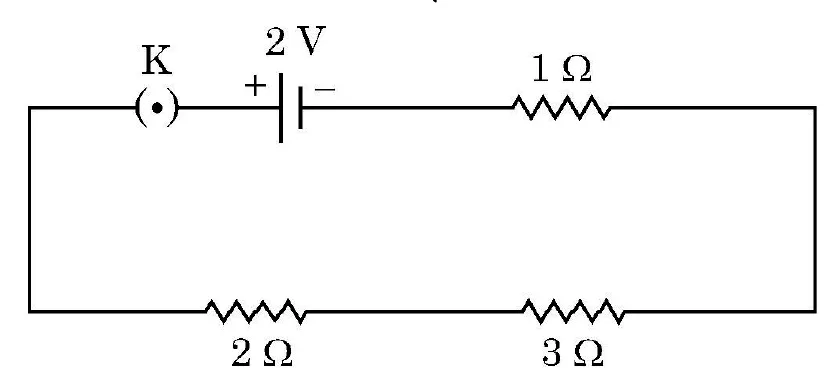
Official answer
The potential difference across the resistor can be calculated using Ohm's law, which states that the potential difference (V) across a conductor is equal to the product of the current (I) flowing through it and its resistance (R). In this case, the current flowing through the resistor is A, and the resistance is . Therefore, the potential difference across the resistor is V.
Marking scheme
- 1.Current (I) = 2 A
- 2.Resistance (R) = 3 \Omega
- 3.Potential difference (V) = I \times R = 2 \times 3 = 6 V
Hint
Use Ohm's law to calculate the potential difference across the resistor.
Quick oral answer
To determine the potential difference across the resistor, we need to apply Ohm's law, which states that the potential difference (V) across a conductor is equal to the product of the current (I) flowing through it and its resistance (R). In this case, the current flowing through the resistor is A, and the resistance is . Therefore, the potential difference across the resistor is V.
Common mistakes
- 1.Forgetting to apply Ohm's law
- 2.Incorrectly calculating the potential difference
Analysis and explanation
Ohm's law is a fundamental principle in electricity that relates the potential difference across a conductor to the current flowing through it and its resistance. In this problem, we are given the current and resistance values, and we need to calculate the potential difference across the resistor. By applying Ohm's law, we can determine the potential difference as 6 V.
Interesting facts
Ohm's law is named after Georg Simon Ohm, a German physicist who discovered the relationship between voltage, current, and resistance in 1827.
Ohm's law is widely used in electrical engineering and electronics to design and analyze circuits.
Question details
Q25 of 39 questions
- Board
- CBSE
- Class
- Class 10
- Subject
- Science
- Year
- 2024
- Section
- Section B
- Marks
- 2
- Type
- Very Short Answer
- Chapter
- Chemical Reactions and Equations
- Topic
- Ohm's Law
- Bloom's level
- Knowledge
- Syllabus topic
- Electricity
Spotted a mistake or something unclear?
Tell us and we will fix it.
Frequently asked questions
How many marks does this question carry in CBSE Class 10 Science 2024?
This question carries 2 marks in the CBSE Class 10 Science 2024 examination.
Which chapter does this question come from in Science?
This question is from the chapter "Chemical Reactions and Equations" in the CBSE Class 10 Science syllabus.
What topic does this question cover in Science?
This question covers the topic "Ohm's Law" from CBSE Class 10 Science.
What type of question is this in the CBSE Class 10 Science 2024 paper?
This is a Very Short Answer question from Section B in the CBSE Class 10 Science 2024 paper.