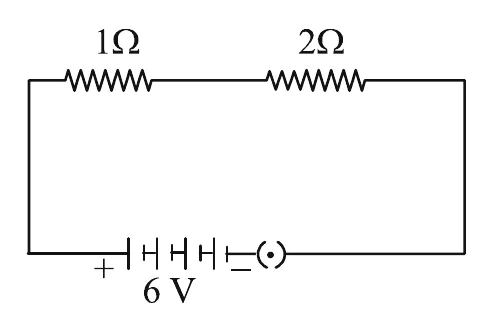
(A) Show how you would connect three resistors each of resistance , so that the combination has a resistance of . Also justify your answer. OR (B) In the given circuit calculate the power consumed in watts in the resistor of :
(A) Show how you would connect three resistors each of resistance , so that the combination has a resistance of . Also justify your answer. OR (B) In the given circuit calculate the power consumed in watts in the resistor of :
Official answer
To connect three resistors each of resistance so that the combination has a resistance of , we can connect them in parallel. This is because when resistors are connected in parallel, the total resistance is less than any of the individual resistances. The formula for the total resistance of resistors connected in parallel is: rac{1}{R_{total}} = rac{1}{R_1} + rac{1}{R_2} + rac{1}{R_3} where is the total resistance and , , and are the individual resistances. In this case, we have: rac{1}{R_{total}} = rac{1}{6} + rac{1}{6} + rac{1}{6} = rac{3}{6} = rac{1}{2} Therefore, the total resistance is . However, we want the total resistance to be , so we need to adjust the connection. One way to do this is to connect two of the resistors in series and then connect the third resistor in parallel with the series combination. The formula for the total resistance of resistors connected in series is: In this case, we have: Now, we can connect the third resistor in parallel with the series combination: rac{1}{R_{total}} = rac{1}{12} + rac{1}{6} = rac{3}{12} = rac{1}{4} Therefore, the total resistance is . However, we still need to adjust the connection to get a total resistance of . One way to do this is to add another resistor in series with the parallel combination. Let's call this resistor . The formula for the total resistance of resistors connected in series is: In this case, we have: We want the total resistance to be , so we can set up the equation: Solving for , we get: Therefore, we need to add a resistor of in series with the parallel combination to get a total resistance of .
Marking scheme
- 1.Connect two of the resistors in series.
- 2.Connect the third resistor in parallel with the series combination.
- 3.Add another resistor in series with the parallel combination to get a total resistance of .
Hint
Use the formulas for the total resistance of resistors connected in series and parallel to solve this problem.
Quick oral answer
To connect three resistors each of resistance so that the combination has a resistance of , we can connect them in parallel. However, we need to adjust the connection to get a total resistance of . One way to do this is to connect two of the resistors in series and then connect the third resistor in parallel with the series combination. We can then add another resistor in series with the parallel combination to get a total resistance of .
Common mistakes
- 1.Connecting all three resistors in series.
- 2.Connecting all three resistors in parallel.
Analysis and explanation
The key to solving this problem is to understand how to connect resistors in series and parallel to achieve a desired total resistance. By connecting two of the resistors in series and then connecting the third resistor in parallel with the series combination, we can get a total resistance of . However, we still need to adjust the connection to get a total resistance of . By adding another resistor in series with the parallel combination, we can achieve the desired total resistance.
Interesting facts
The total resistance of resistors connected in series is always greater than any of the individual resistances.
The total resistance of resistors connected in parallel is always less than any of the individual resistances.
Question details
Q25 of 39 questions
- Board
- CBSE
- Class
- Class 10
- Subject
- Science
- Year
- 2024
- Section
- Section B
- Marks
- 2
- Type
- Very Short Answer
- Chapter
- Electricity
- Topic
- Electric Circuits
- Bloom's level
- Understanding
- Syllabus topic
- Electric Circuits
Spotted a mistake or something unclear?
Tell us and we will fix it.
Frequently asked questions
How many marks does this question carry in CBSE Class 10 Science 2024?
This question carries 2 marks in the CBSE Class 10 Science 2024 examination.
Which chapter does this question come from in Science?
This question is from the chapter "Electricity" in the CBSE Class 10 Science syllabus.
What topic does this question cover in Science?
This question covers the topic "Electric Circuits" from CBSE Class 10 Science.
What type of question is this in the CBSE Class 10 Science 2024 paper?
This is a Very Short Answer question from Section B in the CBSE Class 10 Science 2024 paper.