(A) (i) Why is an alternating current (A.C.) considered to be advantageous over direct current (D.C.) for the long distance transmission of electric power?
(ii) How is the type of current used in household supply different from the one given by a battery of dry cells?
(iii) How does an electric fuse prevent the electric circuit and the appliances from a possible damage due to short circuiting or overloading.
OR
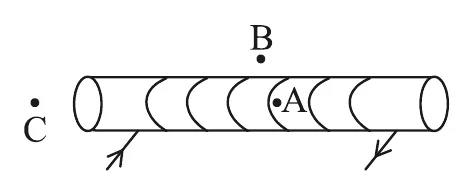
(B) For the current carrying solenoid as shown, draw magnetic field lines and give reason to explain that out of the three points A, B and C, at which point the field strength is maximum and at which point it is minimum?
(A) (i) Why is an alternating current (A.C.) considered to be advantageous over direct current (D.C.) for the long distance transmission of electric power?
(ii) How is the type of current used in household supply different from the one given by a battery of dry cells?
(iii) How does an electric fuse prevent the electric circuit and the appliances from a possible damage due to short circuiting or overloading.
OR
(B) For the current carrying solenoid as shown, draw magnetic field lines and give reason to explain that out of the three points A, B and C, at which point the field strength is maximum and at which point it is minimum?
Official answer
(i) Alternating current (A.C.) is considered to be advantageous over direct current (D.C.) for the long distance transmission of electric power because it can be easily transformed to high voltage using a transformer, which reduces energy loss during transmission.
(ii) The type of current used in household supply is alternating current (A.C.), whereas the one given by a battery of dry cells is direct current (D.C.).
(iii) An electric fuse prevents the electric circuit and the appliances from a possible damage due to short circuiting or overloading by melting and breaking the circuit when the current exceeds a certain limit.
Marking scheme
- 1.Advantages of A.C. over D.C. for long distance transmission of electric power
- 2.Difference between A.C. and D.C. in household supply and battery of dry cells
- 3.Working principle of an electric fuse and its role in preventing damage to the electric circuit and appliances
Hint
The student should recall the advantages of A.C. over D.C. for long distance transmission of electric power, and the difference between A.C. and D.C. in household supply and battery of dry cells. The student should also understand the working principle of an electric fuse and its role in preventing damage to the electric circuit and appliances.
Quick oral answer
Alternating current is used for long distance transmission of electric power because it can be easily transformed to high voltage using a transformer, which reduces energy loss during transmission. The type of current used in household supply is alternating current, whereas the one given by a battery of dry cells is direct current. An electric fuse prevents the electric circuit and the appliances from a possible damage due to short circuiting or overloading by melting and breaking the circuit when the current exceeds a certain limit.
Common mistakes
- 1.Confusing A.C. with D.C.
- 2.Not understanding the working principle of an electric fuse
Analysis and explanation
The question requires the student to explain the advantages of alternating current (A.C.) over direct current (D.C.) for long distance transmission of electric power, and to describe the difference between the type of current used in household supply and the one given by a battery of dry cells. Additionally, the student needs to explain how an electric fuse prevents damage to the electric circuit and appliances due to short circuiting or overloading.
Interesting facts
The first practical alternating current system was developed by Nikola Tesla and George Westinghouse in the late 1880s.
The use of electric fuses dates back to the early 19th century, when they were used to protect telegraph lines from damage caused by lightning strikes.
Question details
Q32 of 39 questions
- Board
- CBSE
- Class
- Class 10
- Subject
- Science
- Year
- 2023
- Section
- Section C
- Marks
- 3
- Type
- Short Answer
- Chapter
- Magnetic Effects of Electric Current
- Topic
- Magnetic Field
- Bloom's level
- Application
- Syllabus topic
- Magnetic Field
Spotted a mistake or something unclear?
Tell us and we will fix it.
Frequently asked questions
How many marks does this question carry in CBSE Class 10 Science 2023?
This question carries 3 marks in the CBSE Class 10 Science 2023 examination.
Which chapter does this question come from in Science?
This question is from the chapter "Magnetic Effects of Electric Current" in the CBSE Class 10 Science syllabus.
What topic does this question cover in Science?
This question covers the topic "Magnetic Field" from CBSE Class 10 Science.
What type of question is this in the CBSE Class 10 Science 2023 paper?
This is a Short Answer question from Section C in the CBSE Class 10 Science 2023 paper.