(i) How is electric current related to the potential difference across the terminals of a conductor ? Draw a labelled circuit diagram to verify this relationship.
(ii) Why should an ammeter have low resistance ?
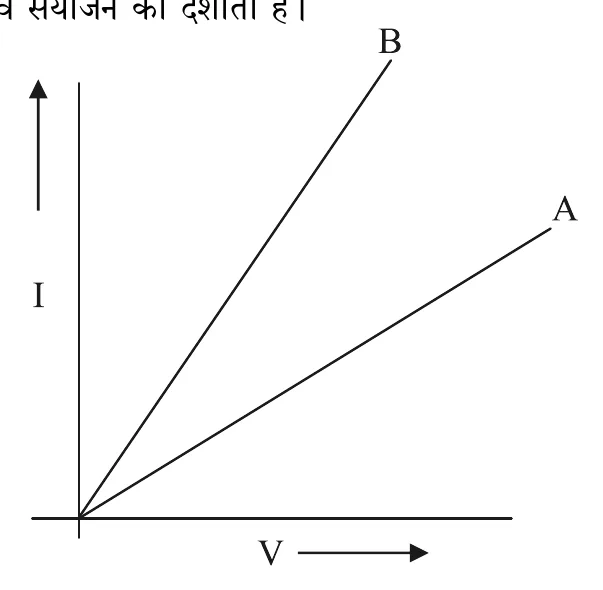
(iii) Two V - I graphs A and B for series and parallel combinations of two resistors are as shown. Giving reason state which graph shows (a) series, (b) parallel combination of the resistors.
(i) How is electric current related to the potential difference across the terminals of a conductor ? Draw a labelled circuit diagram to verify this relationship.
(ii) Why should an ammeter have low resistance ?
(iii) Two V - I graphs A and B for series and parallel combinations of two resistors are as shown. Giving reason state which graph shows (a) series, (b) parallel combination of the resistors.
Official answer
(i) Electric current is directly proportional to the potential difference across the terminals of a conductor. This relationship is known as Ohm's Law, which states that V = IR, where V is the potential difference, I is the current, and R is the resistance of the conductor.
(ii) An ammeter should have low resistance so that it does not affect the current flowing through the circuit. If the ammeter has high resistance, it will reduce the current flowing through the circuit, which can lead to inaccurate readings.
(iii) Graph A shows the series combination of two resistors, while graph B shows the parallel combination of two resistors. In a series combination, the current flowing through each resistor is the same, while in a parallel combination, the voltage across each resistor is the same. Therefore, graph A represents the series combination, and graph B represents the parallel combination.
Marking scheme
- 1.Understanding the relationship between electric current and potential difference across the terminals of a conductor
- 2.Applying Ohm's Law to calculate the resistance of a conductor
- 3.Analyzing the graphs provided to determine which one represents the series combination and which one represents the parallel combination of resistors
Hint
To solve this question, focus on understanding the relationship between electric current and potential difference across the terminals of a conductor. Use Ohm's Law to calculate the resistance of a conductor and analyze the graphs provided to determine which one represents the series combination and which one represents the parallel combination of resistors.
Quick oral answer
Electric current is directly proportional to the potential difference across the terminals of a conductor. This relationship is known as Ohm's Law, which states that V = IR, where V is the potential difference, I is the current, and R is the resistance of the conductor. An ammeter should have low resistance so that it does not affect the current flowing through the circuit. Graph A shows the series combination of two resistors, while graph B shows the parallel combination of two resistors.
Common mistakes
- 1.Confusing the relationship between electric current and potential difference across the terminals of a conductor
- 2.Not applying Ohm's Law correctly to calculate the resistance of a conductor
- 3.Not analyzing the graphs provided correctly to determine which one represents the series combination and which one represents the parallel combination of resistors
Analysis and explanation
The question requires us to understand the fundamental concepts of electric current, potential difference, and resistance. We need to apply Ohm's Law to calculate the resistance of a conductor and understand how it affects the current flowing through a circuit. We also need to analyze the graphs provided to determine which one represents the series combination and which one represents the parallel combination of resistors.
Interesting facts
Ohm's Law was discovered by Georg Simon Ohm in 1827
The unit of resistance is named after Ohm
The concept of electric current and potential difference is crucial in understanding many electrical phenomena
Question details
Q36 of 39 questions
- Board
- CBSE
- Class
- Class 10
- Subject
- Science
- Year
- 2023
- Section
- Section D
- Marks
- 5
- Type
- Long Answer
- Chapter
- Electricity
- Topic
- Electric Current and Circuit
- Bloom's level
- Analyzing
- Syllabus topic
- Electric Current and Circuit
Spotted a mistake or something unclear?
Tell us and we will fix it.
Frequently asked questions
How many marks does this question carry in CBSE Class 10 Science 2023?
This question carries 5 marks in the CBSE Class 10 Science 2023 examination.
Which chapter does this question come from in Science?
This question is from the chapter "Electricity" in the CBSE Class 10 Science syllabus.
What topic does this question cover in Science?
This question covers the topic "Electric Current and Circuit" from CBSE Class 10 Science.
What type of question is this in the CBSE Class 10 Science 2023 paper?
This is a Long Answer question from Section D in the CBSE Class 10 Science 2023 paper.