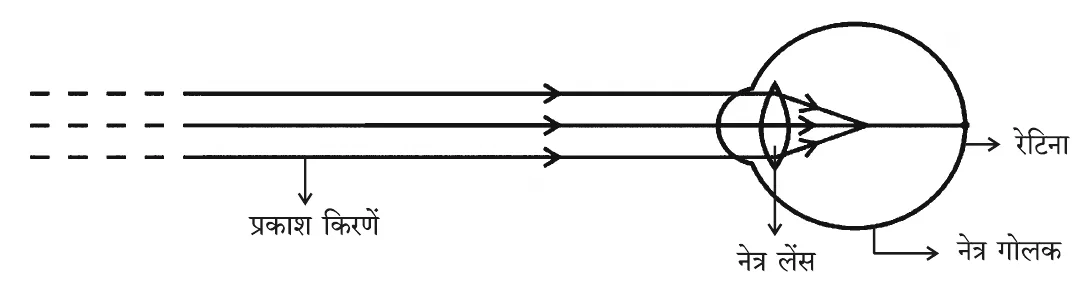
(A) Observe the following diagram and answer the questions following it :
(i) Identify the defect of vision shown.
(ii) List its two causes.
(iii) Name the type of lens used for the correction of this defect.
OR
(B) The colour of clear sky from the earth appears blue but from the space it appears black. Why ?
(A) Observe the following diagram and answer the questions following it :
(i) Identify the defect of vision shown.
(ii) List its two causes.
(iii) Name the type of lens used for the correction of this defect.
OR
(B) The colour of clear sky from the earth appears blue but from the space it appears black. Why ?
Official answer
(i) The defect of vision shown is myopia or near-sightedness.
(ii) The two causes of myopia are excessive curvature of the eye lens and elongation of the eyeball.
(iii) The type of lens used for the correction of this defect is a concave lens.
OR
(B) The colour of clear sky from the earth appears blue because of scattering of light by the atmosphere. From space, it appears black because there is no atmosphere to scatter the light.
Marking scheme
- 1.(i) Myopia or near-sightedness
- 2.(ii) Excessive curvature of the eye lens and elongation of the eyeball
- 3.(iii) Concave lens
Hint
The diagram shows a myopic eye, which is characterized by the image being formed in front of the retina. This occurs due to excessive curvature of the eye lens or elongation of the eyeball. To correct this defect, a concave lens is used, which spreads out the light rays and allows them to focus on the retina. The colour of the clear sky from the earth appears blue because of scattering of light by the atmosphere. When sunlight enters the earth's atmosphere, it encounters tiny molecules of gases such as nitrogen and oxygen. These molecules scatter the shorter (blue) wavelengths more than the longer (red) wavelengths, resulting in the blue colour of the sky. From space, the sky appears black because there is no atmosphere to scatter the light.
Quick oral answer
The diagram shows a myopic eye, which is characterized by the image being formed in front of the retina. This occurs due to excessive curvature of the eye lens or elongation of the eyeball. To correct this defect, a concave lens is used, which spreads out the light rays and allows them to focus on the retina. The colour of the clear sky from the earth appears blue because of scattering of light by the atmosphere. When sunlight enters the earth's atmosphere, it encounters tiny molecules of gases such as nitrogen and oxygen. These molecules scatter the shorter (blue) wavelengths more than the longer (red) wavelengths, resulting in the blue colour of the sky. From space, the sky appears black because there is no atmosphere to scatter the light.
Common mistakes
- 1.The diagram shows a hypermetropic eye, not a myopic eye.
- 2.The colour of the clear sky from the earth appears red, not blue.
- 3.The sky appears blue from space, not black.
Analysis and explanation
The diagram shows a myopic eye, which is characterized by the image being formed in front of the retina. This occurs due to excessive curvature of the eye lens or elongation of the eyeball. To correct this defect, a concave lens is used, which spreads out the light rays and allows them to focus on the retina.
The colour of the clear sky from the earth appears blue because of scattering of light by the atmosphere. When sunlight enters the earth's atmosphere, it encounters tiny molecules of gases such as nitrogen and oxygen. These molecules scatter the shorter (blue) wavelengths more than the longer (red) wavelengths, resulting in the blue colour of the sky. From space, the sky appears black because there is no atmosphere to scatter the light.
Interesting facts
Myopia is a common vision problem that affects millions of people worldwide.
The colour of the sky can change depending on the time of day and the amount of dust and pollution in the air.
The sky appears black from space because there is no atmosphere to scatter the light.
Question details
Q25 of 39 questions
- Board
- CBSE
- Class
- Class 10
- Subject
- Science
- Year
- 2023
- Section
- Section B
- Marks
- 2
- Type
- Very Short Answer
- Chapter
- The Human Eye and the Colourful World
- Topic
- Defects of Vision
- Bloom's level
- Knowledge
- Syllabus topic
- Defects of Vision
Spotted a mistake or something unclear?
Tell us and we will fix it.
Frequently asked questions
How many marks does this question carry in CBSE Class 10 Science 2023?
This question carries 2 marks in the CBSE Class 10 Science 2023 examination.
Which chapter does this question come from in Science?
This question is from the chapter "The Human Eye and the Colourful World" in the CBSE Class 10 Science syllabus.
What topic does this question cover in Science?
This question covers the topic "Defects of Vision" from CBSE Class 10 Science.
What type of question is this in the CBSE Class 10 Science 2023 paper?
This is a Very Short Answer question from Section B in the CBSE Class 10 Science 2023 paper.