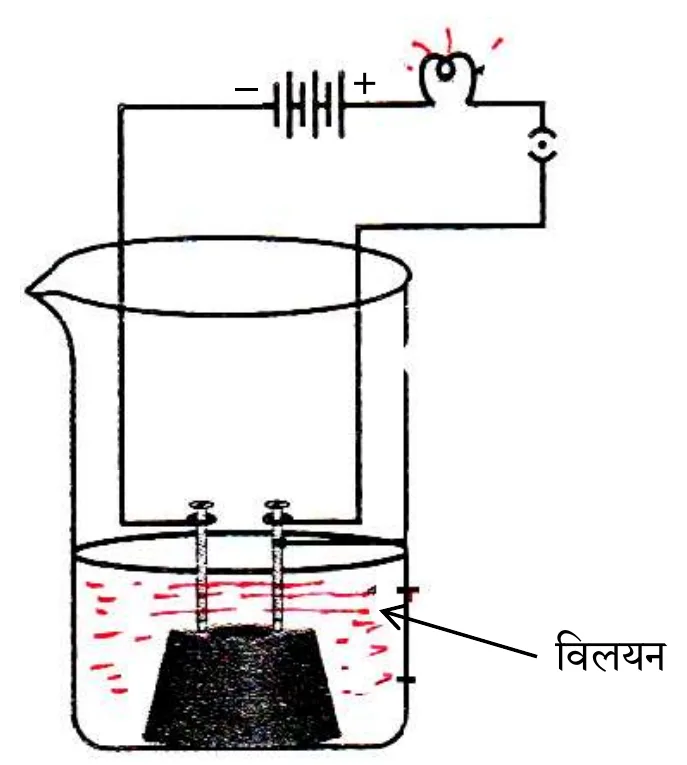
In the given experimental set-up, if the experiment is carried out separately with each of the following solutions the cases in which the bulb will glow is/are :
(i) Dilute hydrochloric acid
(ii) Dilute sulphuric acid
(iii) Glucose solution
(iv) Alcohol
In the given experimental set-up, if the experiment is carried out separately with each of the following solutions the cases in which the bulb will glow is/are :
(i) Dilute hydrochloric acid
(ii) Dilute sulphuric acid
(iii) Glucose solution
(iv) Alcohol
Options
Official answer
The correct answer is (c) (i) and (ii). The bulb will glow when the experiment is carried out with dilute hydrochloric acid and dilute sulphuric acid. This is because these acids are strong electrolytes and can conduct electricity, causing the bulb to glow.
Marking scheme
- 1.(i) only
- 2.(ii) only
- 3.(i) and (ii)
- 4.(ii), (iii) and (iv)
Hint
The student should recall the properties of strong electrolytes and their ability to conduct electricity.
Quick oral answer
The bulb will glow when the experiment is carried out with dilute hydrochloric acid and dilute sulphuric acid because they are strong electrolytes and can conduct electricity.
Common mistakes
- 1.thinking that all acids are strong electrolytes
- 2.not considering the properties of glucose solution and alcohol
Analysis and explanation
This question requires the student to understand the concept of chemical reactions and electrolysis. The student needs to identify the solutions that can conduct electricity and cause the bulb to glow. The correct answer is (c) (i) and (ii), which indicates that the bulb will glow when the experiment is carried out with dilute hydrochloric acid and dilute sulphuric acid.
Interesting facts
strong electrolytes can conduct electricity
glucose solution and alcohol are not good conductors of electricity
Question details
Q2 of 39 questions
- Board
- CBSE
- Class
- Class 10
- Subject
- Science
- Year
- 2023
- Section
- Section A
- Marks
- 1
- Type
- MCQ
- Chapter
- Chemical Reactions and Equations
- Topic
- Chemical Reactions
- Bloom's level
- Comprehension
- Syllabus topic
- Chemical Reactions and Equations
Spotted a mistake or something unclear?
Tell us and we will fix it.
Frequently asked questions
How many marks does this question carry in CBSE Class 10 Science 2023?
This question carries 1 mark in the CBSE Class 10 Science 2023 examination.
Which chapter does this question come from in Science?
This question is from the chapter "Chemical Reactions and Equations" in the CBSE Class 10 Science syllabus.
What topic does this question cover in Science?
This question covers the topic "Chemical Reactions" from CBSE Class 10 Science.
What type of question is this in the CBSE Class 10 Science 2023 paper?
This is a MCQ question from Section A in the CBSE Class 10 Science 2023 paper.