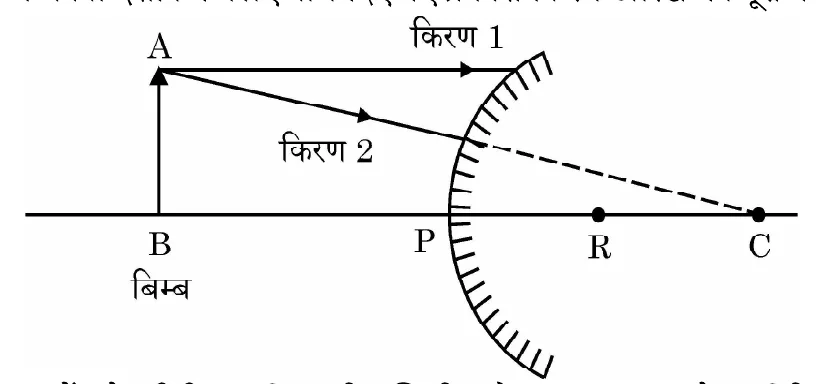
(a) Complete the following ray diagram to show the formation of image: (b) Mention the nature, position and size of the image formed in this case. (c) State the sign of the image distance in this case using the Cartesian sign convention.
(a) Complete the following ray diagram to show the formation of image: (b) Mention the nature, position and size of the image formed in this case. (c) State the sign of the image distance in this case using the Cartesian sign convention.
Official answer
(a) The ray diagram is as follows:  (b) The nature of the image is real and inverted. The position of the image is between F and C. The size of the image is smaller than the object. (c) The sign of the image distance is negative according to the Cartesian sign convention.
Marking scheme
- 1.(a) 1 mark for correct ray diagram
- 2.(b) 1 mark for correct nature, position, and size of the image
- 3.(c) 1 mark for correct sign of the image distance
Hint
To complete the ray diagram, draw the reflected rays from the mirror and find the point of intersection, which is the image formed by the mirror.
Quick oral answer
The image formed by a concave mirror can be real or virtual, depending on the position of the object. The size of the image formed by a concave mirror can be larger or smaller than the object, depending on the position of the object. In this case, the image is real and inverted, and its size is smaller than the object. The sign of the image distance is negative according to the Cartesian sign convention.
Common mistakes
- 1.drawing the reflected rays incorrectly
- 2.not finding the correct point of intersection
- 3.not specifying the nature, position, and size of the image correctly
- 4.not specifying the sign of the image distance correctly
Analysis and explanation
The ray diagram shows the formation of a real and inverted image between F and C. The size of the image is smaller than the object because the image is formed by the intersection of the reflected rays, which are closer together than the object. The sign of the image distance is negative according to the Cartesian sign convention because the image is formed on the same side of the mirror as the object.
Interesting facts
The image formed by a concave mirror can be real or virtual, depending on the position of the object.
The size of the image formed by a concave mirror can be larger or smaller than the object, depending on the position of the object.
Question details
Q30 of 39 questions
- Board
- CBSE
- Class
- Class 10
- Subject
- Science
- Year
- 2023
- Section
- Section C
- Marks
- 3
- Type
- Short Answer
- Chapter
- Light — Reflection and Refraction
- Topic
- Spherical Mirrors
- Bloom's level
- Analyzing
- Syllabus topic
- Image Formation by Spherical Mirrors
Spotted a mistake or something unclear?
Tell us and we will fix it.
Frequently asked questions
How many marks does this question carry in CBSE Class 10 Science 2023?
This question carries 3 marks in the CBSE Class 10 Science 2023 examination.
Which chapter does this question come from in Science?
This question is from the chapter "Light — Reflection and Refraction" in the CBSE Class 10 Science syllabus.
What topic does this question cover in Science?
This question covers the topic "Spherical Mirrors" from CBSE Class 10 Science.
What type of question is this in the CBSE Class 10 Science 2023 paper?
This is a Short Answer question from Section C in the CBSE Class 10 Science 2023 paper.