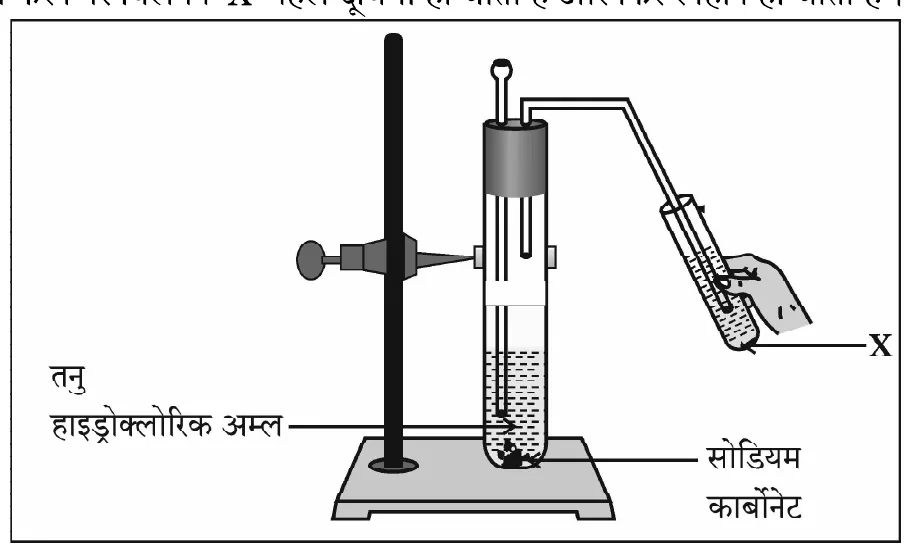
In the experimental setup given below, it is observed that on passing the gas produced in the reaction in the solution 'X' the solution 'X' first turns milky and then colourless. The option that justifies the above stated observation is that 'X' is aqueous calcium hydroxide and
In the experimental setup given below, it is observed that on passing the gas produced in the reaction in the solution 'X' the solution 'X' first turns milky and then colourless. The option that justifies the above stated observation is that 'X' is aqueous calcium hydroxide and
Options
Official answer
The correct option is (b) it turns milky due to formation of calcium carbonate and on passing excess of carbon dioxide it becomes colourless due to formation of calcium hydrogen carbonate which is soluble in water.
Marking scheme
- 1.1 mark for correct option
- 2.0 marks for incorrect options
Hint
The reaction between carbon dioxide and calcium hydroxide involves the formation of calcium carbonate and calcium hydrogen carbonate.
Quick oral answer
The correct option is (b) because the reaction between carbon dioxide and calcium hydroxide first forms calcium carbonate, which is insoluble in water and turns the solution milky. Then, on passing excess carbon dioxide, calcium hydrogen carbonate is formed, which is soluble in water and turns the solution colorless.
Common mistakes
- 1.confusing the order of reactions
- 2.not considering the solubility of calcium carbonate and calcium hydrogen carbonate
Analysis and explanation
The correct option is (b) because the reaction between carbon dioxide and calcium hydroxide first forms calcium carbonate, which is insoluble in water and turns the solution milky. Then, on passing excess carbon dioxide, calcium hydrogen carbonate is formed, which is soluble in water and turns the solution colorless.
Interesting facts
Calcium hydroxide is commonly used in construction and manufacturing.
Carbon dioxide is a greenhouse gas that contributes to climate change.
Question details
Q1 of 39 questions
- Board
- CBSE
- Class
- Class 10
- Subject
- Science
- Year
- 2023
- Section
- Section A
- Marks
- 1
- Type
- MCQ
- Chapter
- Acids, Bases and Salts
- Topic
- Acids and Bases
- Bloom's level
- Comprehension
- Syllabus topic
- Acids and Bases
Spotted a mistake or something unclear?
Tell us and we will fix it.
Frequently asked questions
How many marks does this question carry in CBSE Class 10 Science 2023?
This question carries 1 mark in the CBSE Class 10 Science 2023 examination.
Which chapter does this question come from in Science?
This question is from the chapter "Acids, Bases and Salts" in the CBSE Class 10 Science syllabus.
What topic does this question cover in Science?
This question covers the topic "Acids and Bases" from CBSE Class 10 Science.
What type of question is this in the CBSE Class 10 Science 2023 paper?
This is a MCQ question from Section A in the CBSE Class 10 Science 2023 paper.