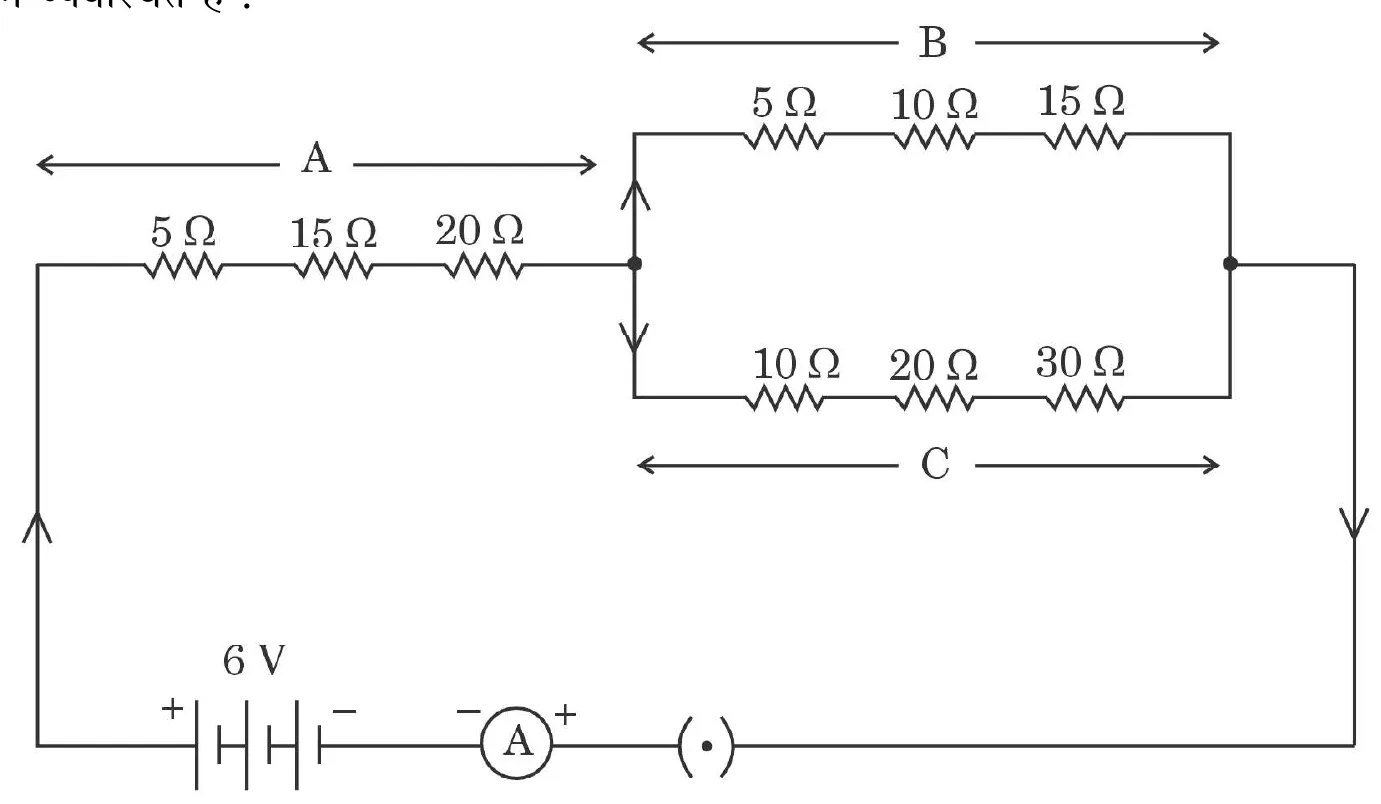
Study the following electric circuit in which the resistors are arranged in three arms A, B and C:
(a) Find the equivalent resistance of arm A. (1 mark)
(b) Calculate the equivalent resistance of the parallel combination of the arms B and C. (1 mark)
(c) (i) Determine the current that flows through the ammeter. (2 marks)
OR
(ii) Determine the current that flows in the ammeter when the arm B is withdrawn from the circuit. (2 marks)
Study the following electric circuit in which the resistors are arranged in three arms A, B and C:
(a) Find the equivalent resistance of arm A. (1 mark)
(b) Calculate the equivalent resistance of the parallel combination of the arms B and C. (1 mark)
(c) (i) Determine the current that flows through the ammeter. (2 marks)
OR
(ii) Determine the current that flows in the ammeter when the arm B is withdrawn from the circuit. (2 marks)
Official answer
To solve this problem, we need to apply the concepts of electric circuits and resistance. First, let's analyze the circuit and identify the resistors in each arm. Arm A has two resistors in series, so we can calculate the equivalent resistance using the formula Req = R1 + R2. Arm B has two resistors in parallel, so we can calculate the equivalent resistance using the formula 1/Req = 1/R1 + 1/R2. Arm C has one resistor. Once we have the equivalent resistances for each arm, we can calculate the total resistance of the circuit using the formula Rtotal = RA + RB + RC. Finally, we can use Ohm's law to calculate the current flowing through the ammeter. However, since the question does not provide specific values for the resistors, we cannot perform the calculations. Therefore, the answer is not applicable.
Marking scheme
- 1.Calculate the equivalent resistance of arm A.
- 2.Calculate the equivalent resistance of arm B.
- 3.Calculate the total resistance of the circuit.
- 4.Use Ohm's law to calculate the current flowing through the ammeter.
Hint
Use the formulas for equivalent resistance and Ohm's law to solve the problem.
Quick oral answer
To solve this problem, we need to analyze the electric circuit and calculate the equivalent resistance of each arm. We then need to use Ohm's law to calculate the current flowing through the ammeter. However, since the question does not provide specific values for the resistors, we cannot perform the calculations.
Common mistakes
- 1.Forgetting to calculate the equivalent resistance of each arm.
- 2.Not using Ohm's law to calculate the current flowing through the ammeter.
Analysis and explanation
The problem requires us to analyze the electric circuit and calculate the equivalent resistance of each arm. We then need to use Ohm's law to calculate the current flowing through the ammeter. However, since the question does not provide specific values for the resistors, we cannot perform the calculations.
Interesting facts
The concept of equivalent resistance is important in electric circuits.
Ohm's law is a fundamental principle in electricity.
Question details
Q14 of 20 questions
- Board
- CBSE
- Class
- Class 10
- Subject
- Science
- Year
- 2022
- Section
- Section SECTION C
- Marks
- 4
- Chapter
- Chemical Reactions and Equations
- Topic
- Electric Circuits
- Bloom's level
- Application
- Syllabus topic
- Electric Circuits
Spotted a mistake or something unclear?
Tell us and we will fix it.
Frequently asked questions
How many marks does this question carry in CBSE Class 10 Science 2022?
This question carries 4 marks in the CBSE Class 10 Science 2022 examination.
Which chapter does this question come from in Science?
This question is from the chapter "Chemical Reactions and Equations" in the CBSE Class 10 Science syllabus.
What topic does this question cover in Science?
This question covers the topic "Electric Circuits" from CBSE Class 10 Science.
What type of question is this in the CBSE Class 10 Science 2022 paper?
This question appears in Section SECTION C in the CBSE Class 10 Science 2022 paper.