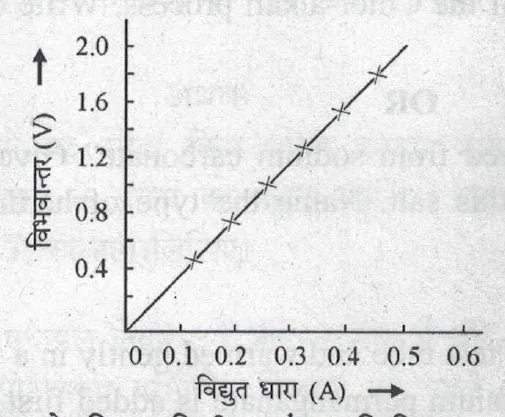
A V-I graph for a nichrome wire is given below. What do you infer from this graph? Draw a labelled circuit diagram to obtain such a graph.
A V-I graph for a nichrome wire is given below. What do you infer from this graph? Draw a labelled circuit diagram to obtain such a graph.
Official answer
The graph shows a straight line passing through the origin, indicating that the current flowing through the nichrome wire is directly proportional to the potential difference across it. This is in accordance with Ohm's Law, which states that the current flowing through a conductor is directly proportional to the potential difference across its ends, provided the temperature remains constant.
Marking scheme
- 1.The graph shows a straight line passing through the origin, indicating that the current flowing through the nichrome wire is directly proportional to the potential difference across it. This is in accordance with Ohm's Law, which states that the current flowing through a conductor is directly proportional to the potential difference across its ends, provided the temperature remains constant.
Hint
The graph shows a straight line passing through the origin, indicating that the current flowing through the nichrome wire is directly proportional to the potential difference across it. This is in accordance with Ohm's Law, which states that the current flowing through a conductor is directly proportional to the potential difference across its ends, provided the temperature remains constant.
Quick oral answer
The graph shows a straight line passing through the origin, indicating that the current flowing through the nichrome wire is directly proportional to the potential difference across it. This is in accordance with Ohm's Law, which states that the current flowing through a conductor is directly proportional to the potential difference across its ends, provided the temperature remains constant.
Common mistakes
- 1.The graph shows a straight line passing through the origin, indicating that the current flowing through the nichrome wire is directly proportional to the potential difference across it. This is in accordance with Ohm's Law, which states that the current flowing through a conductor is directly proportional to the potential difference across its ends, provided the temperature remains constant.
Analysis and explanation
The graph shows a straight line passing through the origin, indicating that the current flowing through the nichrome wire is directly proportional to the potential difference across it. This is in accordance with Ohm's Law, which states that the current flowing through a conductor is directly proportional to the potential difference across its ends, provided the temperature remains constant.
Interesting facts
The graph shows a straight line passing through the origin, indicating that the current flowing through the nichrome wire is directly proportional to the potential difference across it. This is in accordance with Ohm's Law, which states that the current flowing through a conductor is directly proportional to the potential difference across its ends, provided the temperature remains constant.
Question details
Q23 of 39 questions
- Board
- CBSE
- Class
- Class 10
- Subject
- Science
- Year
- 2020
- Section
- Section B
- Marks
- 3
- Type
- Short Answer
- Chapter
- Electricity
- Topic
- Ohm's Law
- Bloom's level
- Understanding
- Syllabus topic
- Electricity
Spotted a mistake or something unclear?
Tell us and we will fix it.
Frequently asked questions
How many marks does this question carry in CBSE Class 10 Science 2020?
This question carries 3 marks in the CBSE Class 10 Science 2020 examination.
Which chapter does this question come from in Science?
This question is from the chapter "Electricity" in the CBSE Class 10 Science syllabus.
What topic does this question cover in Science?
This question covers the topic "Ohm's Law" from CBSE Class 10 Science.
What type of question is this in the CBSE Class 10 Science 2020 paper?
This is a Short Answer question from Section B in the CBSE Class 10 Science 2020 paper.