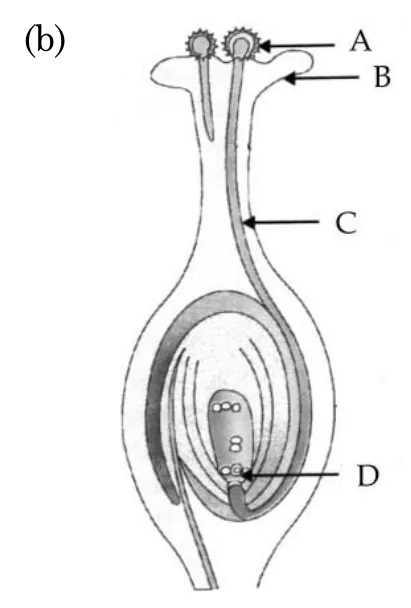
(a) List two reasons for the appearance of variations among the progeny formed by sexual reproduction. (i) Name the part marked ‘A’ in the diagram. (ii) How does ‘A’ reaches part ‘B’? (iii) State the importance of the part ‘C’. (iv) What happens to the part marked ‘D’ after fertilisation is over?
(a) List two reasons for the appearance of variations among the progeny formed by sexual reproduction. (i) Name the part marked ‘A’ in the diagram. (ii) How does ‘A’ reaches part ‘B’? (iii) State the importance of the part ‘C’. (iv) What happens to the part marked ‘D’ after fertilisation is over?
Official answer
(a) Two Reasons for Variations in Sexual Reproduction
- Combining DNA from Two Parents: Sexual reproduction involves combining genetic material (DNA) from two different individuals, creating a completely novel combination of variants.
- Inaccuracies in DNA Copying: The biochemical process of DNA copying during gamete formation is not absolutely accurate, introducing subtle variations in each generation.
(b) Analysis of the Pollen Germination Diagram
``diagram {"xrange": [146.4, 183.6], "yrange": [17.6, 352.4], "points": [{"x": 150.0, "y": 50.0, "label": "A: Pollen Grain"}, {"x": 150.0, "y": 120.0, "label": "B: Stigma"}, {"x": 180.0, "y": 220.0, "label": "C: Pollen Tube"}, {"x": 150.0, "y": 320.0, "label": "D: Ovary / Ovule"}], "caption": "Germination of pollen on stigma"} ``
- (i) Name of Part 'A':
Part A is the Pollen grain.
- (ii) How 'A' reaches 'B':
The pollen grain () reaches the stigma () through the process of pollination. This transfer is achieved by external agents such as wind, water, or animals (like insects).
- (iii) Importance of Part 'C' (Pollen Tube):
Part C is the Pollen tube. Its importance is to grow out of the pollen grain, travel down through the style, and carry the male germ-cell to the ovary so it can reach and fuse with the female gamete (egg cell) inside the ovule.
- (iv) What happens to Part 'D' (Ovary/Ovule/Zygote) after fertilisation:
- If D represents the Zygote: It divides several times to form an embryo inside the ovule.
- If D represents the Ovule: It develops a tough coat and gradually converts into a seed.
- If D represents the Ovary: It grows rapidly and ripens to form a fruit (while other parts like petals and stamens shrivel and fall off).
Marking scheme
- 1.Part (a): Listing two reasons for variations (combining DNA from two parents & DNA copying inaccuracies) (1 mark)
- 2.Part (i) & (ii): Correctly identifying Pollen grain (A) and explaining pollination (0.5 marks)
- 3.Part (iii): Explaining the role of the Pollen tube (C) in carrying the male germ-cell (0.75 marks)
- 4.Part (iv): Describing post-fertilization changes of Ovary (fruit) / Ovule (seed) / Zygote (embryo) (0.75 marks)
Hint
Recall the diagram of 'Germination of pollen on stigma'. Identify the pollen grain, stigma, pollen tube, and ovary/ovule, and think about post-fertilization changes.
Quick oral answer
Part A is the pollen grain, which reaches the stigma (B) via pollination. The pollen tube (C) carries the male gamete to the ovary (D). After fertilization, the zygote forms an embryo, the ovule becomes a seed, and the ovary ripens into a fruit.
Common mistakes
- 1.Confusing pollination with fertilization (pollination is just the transfer of pollen; fertilization is the fusion of germ-cells).
- 2.Mixing up the post-fertilization fates of the ovary (becomes fruit) and ovule (becomes seed).
Analysis and explanation
Sexual reproduction is highly favored in evolution because it accelerates variation. By combining DNA from two pre-existing individuals, each offspring gets a unique genetic makeup. In flowering plants, this process requires pollination (transfer of pollen from stamen to stigma) followed by fertilization. The pollen tube () acts as a conduit for the male gamete to travel through the style to reach the female gamete in the ovary (). Post-fertilization, the zygote becomes an embryo, the ovule becomes a seed, and the ovary matures into a fruit.
Interesting facts
The pollen tube grows extremely rapidly through the style, guided by chemical signals, to ensure the male gamete reaches the egg cell precisely!
Question details
Q11 of 36 questions
- Board
- CBSE
- Class
- Class 10
- Subject
- Science
- Year
- 2016
- Section
- Section A
- Marks
- 3
- Type
- Short Answer
- Chapter
- How do Organisms Reproduce?
- Topic
- Sexual Reproduction in Flowering Plants
- Also asked in
- 2016
- Bloom's level
- Applying
- Syllabus topic
- Sexual reproduction in flowering plants, pollination, fertilization
Spotted a mistake or something unclear?
Tell us and we will fix it.
Frequently asked questions
How many marks does this question carry in CBSE Class 10 Science 2016?
This question carries 3 marks in the CBSE Class 10 Science 2016 examination.
Which chapter does this question come from in Science?
This question is from the chapter "How do Organisms Reproduce?" in the CBSE Class 10 Science syllabus.
What topic does this question cover in Science?
This question covers the topic "Sexual Reproduction in Flowering Plants" from CBSE Class 10 Science.
Has this question appeared in other CBSE Science papers?
Yes, a similar question appeared in the 2016 CBSE Class 10 Science paper.
What type of question is this in the CBSE Class 10 Science 2016 paper?
This is a Short Answer question from Section A in the CBSE Class 10 Science 2016 paper.