Mrignayani was doing the experiment of comparing reactivity of metals in the laboratory. She was given aluminium metal and was told to check reactivity by using four solutions (A, B, C, and D, where A is aluminium sulphate). She would observe that reaction takes place in:
Mrignayani was doing the experiment of comparing reactivity of metals in the laboratory. She was given aluminium metal and was told to check reactivity by using four solutions (A, B, C, and D, where A is aluminium sulphate). She would observe that reaction takes place in:
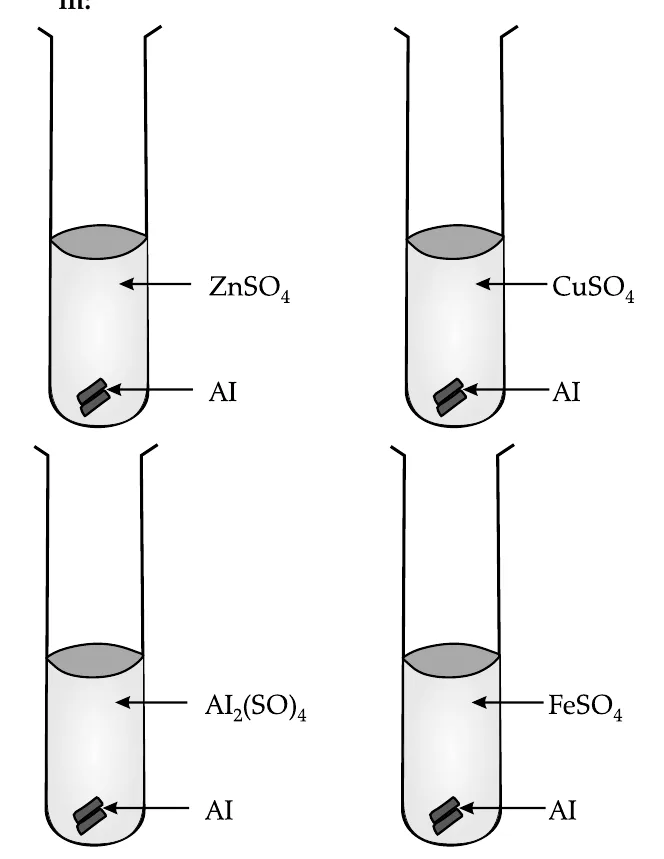
Options
Official answer
C and D
Marking scheme
- 1.1 mark for correct answer
Hint
The reactivity of metals can be determined by observing the reaction with different solutions.
Quick oral answer
The reactivity of metals can be determined by observing the reaction with different solutions. In this case, the reaction takes place in solutions C and D.
Common mistakes
- 1.Confusing the reactivity of metals with their physical properties
Analysis and explanation
The reactivity of metals can be determined by observing the reaction with different solutions. In this case, the reaction takes place in solutions C and D.
Interesting facts
The reactivity of metals can be used to determine their position in the periodic table.
Question details
Q29 of 36 questions
- Board
- CBSE
- Class
- Class 10
- Subject
- Science
- Year
- 2014
- Section
- Section SECTION-B
- Marks
- 1
- Type
- MCQ
- Chapter
- Metals and Non-metals
- Topic
- Reactivity of Metals
- Bloom's level
- Knowledge
- Syllabus topic
- Chemical Properties of Metals
Spotted a mistake or something unclear?
Tell us and we will fix it.
Frequently asked questions
How many marks does this question carry in CBSE Class 10 Science 2014?
This question carries 1 mark in the CBSE Class 10 Science 2014 examination.
Which chapter does this question come from in Science?
This question is from the chapter "Metals and Non-metals" in the CBSE Class 10 Science syllabus.
What topic does this question cover in Science?
This question covers the topic "Reactivity of Metals" from CBSE Class 10 Science.
What type of question is this in the CBSE Class 10 Science 2014 paper?
This is a MCQ question from Section SECTION-B in the CBSE Class 10 Science 2014 paper.