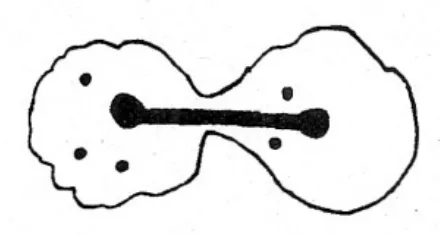
A student draws the following diagram after observing a prepared slide under a microscope. This illustrates
A student draws the following diagram after observing a prepared slide under a microscope. This illustrates
Options
Official answer
formation of daughter cells in yeast
Marking scheme
- 1.1 mark for correct answer
Hint
The diagram shows the formation of daughter cells in yeast, which is a type of unicellular organism.
Quick oral answer
The diagram shows the formation of daughter cells in yeast, which is a type of unicellular organism. The process of formation of daughter cells in yeast is called budding.
Common mistakes
- 1.confusing the diagram with binary fission in amoeba
Analysis and explanation
The diagram shows the formation of daughter cells in yeast, which is a type of unicellular organism. The process of formation of daughter cells in yeast is called budding. In this process, a small bud grows out from the parent cell and eventually separates to form a new individual.
Interesting facts
Yeast is a type of unicellular organism that reproduces by budding.
The process of budding in yeast is a type of asexual reproduction.
Question details
Q37 of 41 questions
- Board
- CBSE
- Class
- Class 10
- Subject
- Science
- Year
- 2012
- Section
- Section B
- Marks
- 1
- Type
- MCQ
- Chapter
- How do Organisms Reproduce?
- Topic
- Reproduction in Unicellular Organisms
- Bloom's level
- Knowledge
- Syllabus topic
- Reproduction in Unicellular Organisms
Spotted a mistake or something unclear?
Tell us and we will fix it.
Frequently asked questions
How many marks does this question carry in CBSE Class 10 Science 2012?
This question carries 1 mark in the CBSE Class 10 Science 2012 examination.
Which chapter does this question come from in Science?
This question is from the chapter "How do Organisms Reproduce?" in the CBSE Class 10 Science syllabus.
What topic does this question cover in Science?
This question covers the topic "Reproduction in Unicellular Organisms" from CBSE Class 10 Science.
What type of question is this in the CBSE Class 10 Science 2012 paper?
This is a MCQ question from Section B in the CBSE Class 10 Science 2012 paper.