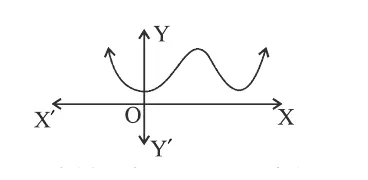
The graph of is given.
The number of zeroes of f(x) is :
(a) 0 (b) 1 (c) 2 (d) 4
The graph of is given.
The number of zeroes of f(x) is :
(a) 0 (b) 1 (c) 2 (d) 4
Options
Official answer
(c) 2 — the graph meets the X-axis at 2 points, so has 2 zeroes (confirm against the printed figure).
Marking scheme
- 1.1 mark for correctly reading the number of X-axis intersection points from the graph (verify against the actual printed figure).
Hint
Count only the points where the curve actually touches or crosses the X-axis — those x-values are the zeroes of .
Quick oral answer
The zeroes of are the x-values where its graph meets the X-axis; here the wavy curve meets the X-axis at 2 points, so has 2 zeroes.
Common mistakes
- 1.Counting the turning points (peaks/troughs) of the curve instead of the X-axis crossing points.
- 2.Miscounting when the curve touches the axis tangentially versus crossing through it.
- 3.Confusing the degree of the polynomial with the number of real zeroes visible on the graph.
Analysis and explanation
Tests reading the number of zeroes of a polynomial from its graph.
Concept
- The zeroes of f(x) are exactly the x-coordinates where the graph of crosses or touches the X-axis, since there.
Key points
- Count only points where the curve meets the X-axis, not turning points (local maxima/minima).
- OCR caveat: the exact count must be confirmed from the printed figure; option (c) 2 corresponds to the standard two-crossing version of this well-known CBSE graph.
Common mistakes
- Counting turning points of the curve instead of X-axis intersections.
- Miscounting tangential touches as full crossings or vice versa.
Real-world/exam link
- Reading zeroes graphically connects directly to factorising and solving polynomial equations algebraically.
Interesting facts
This graph-based zero-counting question format has appeared repeatedly in CBSE Class 10 sample papers since the NCERT graphical approach to polynomials was introduced.
A quadratic polynomial's graph is always a parabola, which can intersect the X-axis at 0, 1 (tangent), or 2 points, corresponding to 0, 1, or 2 real zeroes.
Question details
Q4 of 56 questions
- Board
- CBSE
- Class
- Class 10
- Subject
- Mathematics (Standard)
- Year
- 2026
- Section
- Section A
- Marks
- 1
- Type
- MCQ
- Chapter
- Polynomials
- Topic
- Zeroes of a Polynomial from its Graph
- Bloom's level
- understand
- Syllabus topic
- Unit 2: Algebra — Polynomials: Geometrical Meaning of Zeroes of a Polynomial
- Author
- CBSE
- Reviewed by
- Padhantu Academic Team
Spotted a mistake or something unclear?
Tell us and we will fix it.
Frequently asked questions
What is the geometrical meaning of a zero of a polynomial?
A zero of f(x) is a value of x for which ; geometrically, it is the x-coordinate of the point where the graph of intersects the X-axis.
Can the number of zeroes exceed the degree of the polynomial?
No, a polynomial of degree n can have at most n real zeroes, though the graph may show fewer if some roots are complex or repeated.