OR
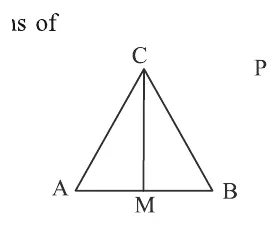
In the given figure, CM and RN are respectively the medians of Δ ABC and Δ PQR. If Δ ABC ~ Δ PQR, then prove that :
(i) Δ AMC ~ Δ PNR
(ii) Δ CMB ~ Δ RNQ
OR
In the given figure, CM and RN are respectively the medians of Δ ABC and Δ PQR. If Δ ABC ~ Δ PQR, then prove that :
(i) Δ AMC ~ Δ PNR
(ii) Δ CMB ~ Δ RNQ
Official answer
Both and are proved by the SAS similarity criterion: from , corresponding angles are equal and sides proportional, and since M, N are midpoints of AB, PQ, , giving the second proportional side for each triangle pair with the already-equal included angle.
Marking scheme
- 1.1 mark: correctly stating Given/To Prove and listing the equal angles and proportional sides from .
- 2.1 mark: correctly showing using M, N as midpoints.
- 3.1 mark: applying SAS similarity criterion (with included angle ) to conclude .
- 4.1 mark: correctly showing using M, N as midpoints.
- 5.1 mark: applying SAS similarity criterion (with included angle ) to conclude .
Hint
Use , (and , ) with the given similarity ratio , then apply SAS similarity using the already-equal included angles and .
Quick oral answer
Since M and N are midpoints of AB and PQ, the median segments AM, PN and BM, QN take exactly half of AB and PQ respectively, so their ratio equals AB/PQ, which matches the already-given similarity ratios; combined with the equal included angles and from , SAS similarity directly gives and .
Common mistakes
- 1.Trying to use AA similarity by inventing a second equal angle instead of correctly applying SAS with the derived side ratio.
- 2.Forgetting to state that and explicitly before equating the ratio to .
- 3.Mixing up which included angle ( vs ) goes with which pair of triangles in the two separate proofs.
Analysis and explanation
This extends similarity to medians, applying the SAS similarity criterion to two derived triangles.
Key insight
- Since M, N are midpoints, , , so , which already equals the known similarity ratio (or for the other pair).
- The included angle (, or ) is inherited unchanged from ΔABC ~ ΔPQR since M, N lie on AB, PQ without altering these angles.
Common mistakes
- Attempting AA similarity by guessing a second angle instead of the cleaner, intended SAS route using one known angle plus the derived median-side ratio.
Broader/real-world significance
- Proves that corresponding medians of similar triangles are proportional to corresponding sides — a result reused for altitudes, angle bisectors, perimeters and areas of similar triangles.
Interesting facts
This result generalises: for any two similar triangles, corresponding medians, altitudes, and angle bisectors are all in the same ratio as the corresponding sides — a property frequently used in area-ratio problems (ratio of areas = square of ratio of corresponding medians).
The median-based similarity proof is a standard NCERT exemplar problem and one of the most repeated 'OR' alternative questions in CBSE Board papers for the Triangles chapter.
This same SAS-based technique can be extended to prove that corresponding altitudes of similar triangles are proportional to corresponding sides, a related and equally common CBSE proof question.
Question details
Q40 of 56 questions
- Board
- CBSE
- Class
- Class 10
- Subject
- Mathematics (Standard)
- Year
- 2026
- Section
- Section D
- Marks
- 5
- Type
- Long Answer
- Chapter
- Triangles
- Topic
- Similarity of Triangles using Medians
- Bloom's level
- analyze
- Syllabus topic
- Unit 3: Geometry — Triangles: Criteria for similarity of triangles (SAS) applied to medians
- Author
- CBSE
- Reviewed by
- Padhantu Academic Team
Spotted a mistake or something unclear?
Tell us and we will fix it.
Frequently asked questions
Why is SAS used here instead of AA similarity?
Only one pair of angles ( or ) is directly known to be equal from the given similarity, along with a derivable side ratio from the median being half of the corresponding side, so SAS (two sides and the included angle) is the applicable and provable criterion, not AA.
Does this proof work only for medians, or for any cevian?
The same reasoning extends to altitudes and angle bisectors of similar triangles as well — any corresponding cevian from a similar triangle pair will be proportional to the corresponding sides, provable by an analogous SAS argument.
What is the practical use of proving corresponding medians are proportional?
It allows calculating unknown median lengths or ratios in one triangle if the corresponding median in a similar triangle is known, useful in problems involving centroids and area ratios of similar triangles.