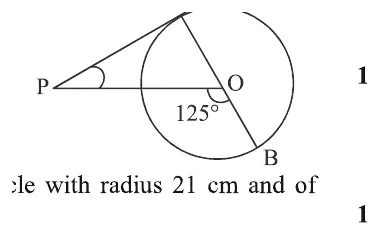
In the given figure, PA is a tangent from an external point P to a circle with centre O. If , then ∠ APO is equal to :
(a) 25° (b) 65° (c) 90° (d) 35°
In the given figure, PA is a tangent from an external point P to a circle with centre O. If , then ∠ APO is equal to :
(a) 25° (b) 65° (c) 90° (d) 35°
Options
Official answer
(d) 35° — since (tangent ⊥ radius) and (linear pair on diameter AOB), so .
Marking scheme
- 1.1 mark: correctly selecting option (d) 35° with valid reasoning — using (tangent ⊥ radius) and (linear pair since A, O, B are collinear), then .
- 2.No partial marks for MCQs — only the final correct option choice earns the mark; working may be shown for self-check but is not separately awarded.
Hint
Tangent ⊥ radius at the point of contact (), and since A, O, B are collinear, .
Quick oral answer
Since PA is a tangent, OA is perpendicular to PA at A, giving a 90° angle. As A, O, B lie on a straight diameter, . In right triangle OAP, .
Common mistakes
- 1.Assuming ∠AOP equals ∠POB (125°) directly instead of realising A, O, B are collinear and applying the linear pair relation to get 55°.
- 2.Forgetting that the tangent is perpendicular to the radius at the point of contact, and hence omitting the 90° angle at A in the triangle OAP.
- 3.Arithmetic slip while subtracting from 180° (e.g., writing and ignoring the sign, or mixing up which two angles to subtract).
Analysis and explanation
Uses the tangent–radius perpendicularity property combined with the linear pair on diameter AOB.
Concept
- Tangent PA ⊥ radius OA at the point of contact, so .
- A, O, B are collinear (AB is a diameter), so ∠AOP and ∠POB form a linear pair: .
Key points
- .
- In right triangle OAP: .
Common mistakes
- Treating ∠AOP as equal to ∠POB instead of using the linear pair.
- Forgetting the tangent ⊥ radius fact and applying the exterior angle theorem to the wrong triangle.
Real-world
- The tangent-perpendicularity principle is used in engineering drawing, gear design, and satellite orbit calculations wherever a straight edge must just touch a circular boundary without crossing it.
Interesting facts
The tangent to a circle is always perpendicular to the radius at the point of contact, a property first rigorously proved in Euclid's Elements (Book III).
Because OA is perpendicular to PA, angle OAP is always 90 degrees, which makes quadrilateral angle-chasing problems like this solvable using the angle sum property of a quadrilateral (360 degrees).
Question details
Q13 of 56 questions
- Board
- CBSE
- Class
- Class 10
- Subject
- Mathematics (Standard)
- Year
- 2026
- Section
- Section A
- Marks
- 1
- Type
- MCQ
- Chapter
- Circles
- Topic
- Tangent to a Circle
- Bloom's level
- apply
- Syllabus topic
- Unit VI: Geometry — Circles: Tangent from an external point, radius perpendicular to tangent
- Author
- CBSE
- Reviewed by
- Padhantu Academic Team
Spotted a mistake or something unclear?
Tell us and we will fix it.
Frequently asked questions
Why is ∠OAP always 90° in this figure?
Because a tangent to a circle is always perpendicular to the radius drawn to the point of contact — this is a fundamental theorem of the Circles chapter.
How do we know A, O, B are on a straight line?
The figure shows AB passing through the centre O, making AB a diameter, so A, O, B are collinear and ∠AOP, ∠POB form a linear pair summing to 180°.