OR
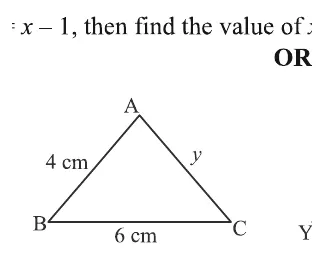
In the figure given above, , then find the values of x and y.
OR
In the figure given above, , then find the values of x and y.
Official answer
and , found using the scale factor from , applied via and .
Marking scheme
- 1.1 mark: correctly setting up using the correct vertex correspondence, and finding the scale factor .
- 2.1 mark: correct final values and .
Hint
Since , match vertices in order (A-X, B-Y, C-Z) to get , then use the fully known pair BC and YZ to find the ratio.
Quick oral answer
Since , corresponding sides are proportional: . Using as the scale factor, I get from AB/XY, and from AC/XZ.
Common mistakes
- 1.Mismatching corresponding sides, e.g., using instead of , by ignoring the strict vertex order in .
- 2.Confusing which side is x and which is y after computing the scale factor, leading to swapped answers.
- 3.Arithmetic errors in simplifying to 5/6 (forgetting to multiply numerator and denominator by 10 first to clear the decimal: ).
Analysis and explanation
OR alternative to Q22 — tests proportional sides via triangle similarity instead of BPT.
Concept
- means corresponding sides are proportional in the strict vertex order : .
Key points
- Using the pair with both lengths known, gives the scale factor.
- ⟹ ⟹ .
- ⟹ ⟹ .
Common mistakes
- Matching sides by apparent size in the figure instead of by the stated correspondence order (A-X, B-Y, C-Z).
Interesting facts
In similar triangles, not only are corresponding sides proportional, but corresponding angles are equal, corresponding medians/altitudes/angle-bisectors are also in the same ratio, and areas are in the ratio of the square of the scale factor.
The scale factor here means is smaller than by that ratio; equivalently, is an enlargement of by a factor of .
Triangle similarity by SSS (all three sides proportional) is one of three main similarity criteria in the CBSE syllabus, alongside AA and SAS similarity.
Question details
Q23 of 56 questions
- Board
- CBSE
- Class
- Class 10
- Subject
- Mathematics (Standard)
- Year
- 2026
- Section
- Section B
- Marks
- 2
- Type
- Very Short Answer
- Chapter
- Triangles
- Topic
- Similarity of Triangles
- Bloom's level
- apply
- Syllabus topic
- Unit 4: Geometry — Triangles: Similar triangles and ratio of corresponding sides
- Author
- CBSE
- Reviewed by
- Padhantu Academic Team
Spotted a mistake or something unclear?
Tell us and we will fix it.
Frequently asked questions
How do you know which sides correspond in ?
The order of vertices in the similarity statement fixes the correspondence: , so , and .
Why use first to find the scale factor?
Because both and are fully known numerical values, this pair directly gives the scale factor , which can then be applied to find the unknowns x and y.