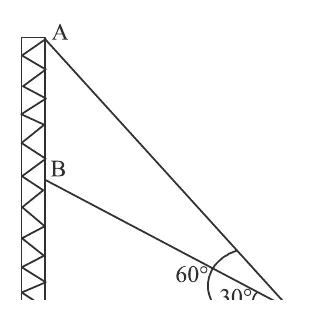
Radio towers are used for transmitting a range of communication services including radio and television. The tower will either act as an antenna itself or support one or more antennas on its structure. On a similar concept, a radio station tower was built in two sections 'A' and 'B'. Tower is supported by wires from a point 'O' (as shown in figure).
Distance between the base of the tower and point 'O' is 6 m. From point 'O', the angle of elevation of the top of the section 'B' is 30° and the angle of elevation of the top of section 'A' is 60°.
Based on the above information, answer the following questions :
Radio towers are used for transmitting a range of communication services including radio and television. The tower will either act as an antenna itself or support one or more antennas on its structure. On a similar concept, a radio station tower was built in two sections 'A' and 'B'. Tower is supported by wires from a point 'O' (as shown in figure).
Distance between the base of the tower and point 'O' is 6 m. From point 'O', the angle of elevation of the top of the section 'B' is 30° and the angle of elevation of the top of section 'A' is 60°.
Based on the above information, answer the following questions :
Official answer
This passage sets up the right-triangle model for the sub-questions. Let P be the foot of the tower, B the top of the lower section, and A the top of the whole tower. In right triangle OPB (angle of elevation of B = 30°, base PO = 6 m): height ≈ 3.46 m, and wire ≈ 6.93 m. In right triangle OPA (angle of elevation of A = 60°): total tower height ≈ 10.39 m, and wire . These two triangles are used to answer the sub-questions that follow.
Marking scheme
- 1.This is a context-setting passage for the case study; marks are awarded in the individual sub-questions (i), (ii), (iii) that follow it.
Hint
Use for each right triangle sharing the base PO = 6 m; higher point A has the larger angle (60°), lower point B has the smaller angle (30°).
Quick oral answer
The tower has two sections; from point O, 6 m from the base, the angle of elevation to the top of the lower section B is 30° and to the top of the whole tower (section A) is 60° — these define two right triangles used to find heights and wire lengths.
Common mistakes
- 1.Swapping the 30° and 60° angles between the upper section A and lower section B.
- 2.Using sine or cosine instead of tangent when relating height to the horizontal base.
- 3.Forgetting that section A's triangle covers the full tower height (P to top), not just the upper section length (B to top).
Analysis and explanation
Sets up the two right-triangle model needed for the sub-questions on the two-section radio tower.
Concept
- Point O and the base P of the tower form a fixed base shared by two right triangles: one to the top of section B (30°) and one to the top of section A, the whole tower (60°).
- Section A is higher, so it uses the steeper angle (60°); section B is lower, using the shallower angle (30°).
Key Points
- Triangle OPB: ; wire .
- Triangle OPA: ; wire .
Common Mistakes
- Swapping the 30° and 60° angles between sections A and B.
Real-World
- Mirrors real guy-wire engineering calculations for radio/telecom towers using two known angles of elevation from one point.
Interesting facts
Real radio and TV transmission towers use guy wires anchored at specific angles for structural stability, and engineers use exactly this kind of trigonometric calculation to determine wire lengths.
The tallest guyed radio mast in the world, the KVLY-TV mast in North Dakota, USA, stands over 600 m tall and relies on multiple sets of angled guy wires very similar in principle to this problem.
Question details
Q47 of 56 questions
- Board
- CBSE
- Class
- Class 10
- Subject
- Mathematics (Standard)
- Year
- 2026
- Section
- Section E
- Marks
- 0
- Chapter
- Some Applications of Trigonometry
- Topic
- Applications of Trigonometry - Heights and Distances (Radio Tower)
- Bloom's level
- understand
- Syllabus topic
- Unit V: Trigonometry — Some Applications of Trigonometry: Heights and Distances using angles of elevation
- Author
- CBSE
- Reviewed by
- Padhantu Academic Team
Spotted a mistake or something unclear?
Tell us and we will fix it.
Frequently asked questions
Why are there two different angles of elevation in this problem?
Because the tower has two sections of different heights — the top of the lower section B is seen at a smaller angle (30°) and the top of the whole tower (section A) is seen at a larger angle (60°) from the same point O.
Which trigonometric ratio should be used here?
The tangent ratio, since it relates the height (opposite side) to the horizontal distance PO (adjacent side) in each right triangle.