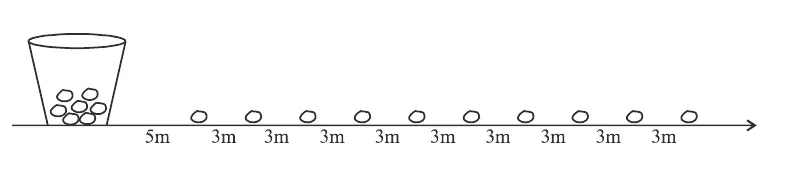
In a potato race, a bucket is placed at the starting point, which is 5 m from the first potato. The other potatoes are arranged 3 m apart in a straight line, with a total of 10 potatoes, as shown in the figure.
A competitor starts from the bucket, picks up the nearest potato, runs back to the bucket to drop it in, then returns to pick up the next potato. This process continues until all the potatoes are in the bucket.
Based on the above information, answer the following questions :
In a potato race, a bucket is placed at the starting point, which is 5 m from the first potato. The other potatoes are arranged 3 m apart in a straight line, with a total of 10 potatoes, as shown in the figure.
A competitor starts from the bucket, picks up the nearest potato, runs back to the bucket to drop it in, then returns to pick up the next potato. This process continues until all the potatoes are in the bucket.
Based on the above information, answer the following questions :
Official answer
This is the introductory passage of Case Study Q36 (Section E), with no marks of its own. It models the nth potato's one-way distance from the bucket as an AP: metres, and the round-trip distance (since the competitor runs there and back) as metres — itself an AP with first term 10 m and common difference 6 m. The numeric answers (distance to the 1st and 2nd potatoes, total distance for all 10, and time at a given speed) are computed in sub-parts Q36(i), (ii), (iii)(a), (iii)(b), which lie outside this range.
Marking scheme
- 1.No marks are allotted directly to this introductory passage; marks are awarded in its sub-questions Q36(i) [1 mark], Q36(ii) [1 mark], and Q36(iii)(a)/(b) [2 marks], based on correctly identifying and applying the AP model described above.
Hint
Model the one-way distance to the nth potato as an AP (, ); double it for the round trip to get a new AP (, ) for total distance calculations in the sub-parts.
Quick oral answer
This passage describes a potato race where the bucket-to-potato distances form an AP with first term 5 m and common difference 3 m; since each potato requires a round trip, the total distance run is found by doubling these terms and summing the first 10 terms of the resulting AP with first term 10 m and common difference 6 m.
Common mistakes
- 1.Forgetting that the competitor must run to the bucket AND back, so failing to double the one-way distance when computing distance covered per potato.
- 2.Incorrectly identifying the common difference as the gap between potatoes (3 m) instead of the actual difference between successive one-way distances from the bucket, which is also 3 m but must be doubled for round-trip distances (giving common difference 6 m).
- 3.Misreading the passage and assuming there are fewer or more than 10 potatoes, which changes the value of n used in later sum calculations.
Analysis and explanation
A real-life, activity-based Case Study passage (Section E) applying Arithmetic Progressions to a potato-race scenario.
Core model
- One-way distance of the nth potato from the bucket: (AP with , ).
- Because the competitor runs out and back, the round-trip distance is double: , itself an AP with , , summed via for the total distance over all 10 potatoes.
Common mistakes
- Forgetting to double the one-way distance for the return trip to the bucket.
Note on marks/structure
- This introductory stem carries no direct marks; scoring occurs across its sub-questions Q36(i), Q36(ii), and Q36(iii)(a)/(b), which progressively test a single term, a specific term, the full sum, and a time-from-speed calculation — all outside the Q37–Q42 range covered here.
Interesting facts
CBSE introduced compulsory case-study/source-based questions (Section E) in Class 10 Maths from the 2020-21 academic session onward, specifically to test application and analytical skills beyond direct formula recall.
The 'potato race' scenario mirrors an actual popular field-day and sports-day game played in schools across India, making this one of the more relatable and frequently used real-life contexts for Arithmetic Progression case studies.
The distances in such potato-race AP problems can be generalised with the formula for total distance run = where a is the distance to the first potato and d is the constant gap — a direct real-world instance of the AP sum formula applied without the usual division by 2, since here it accounts for both the trip and the fixed n multiplier structure.
Question details
Q42 of 56 questions
- Board
- CBSE
- Class
- Class 10
- Subject
- Mathematics (Standard)
- Year
- 2026
- Section
- Section E
- Marks
- 0
- Chapter
- Arithmetic Progressions
- Topic
- Application of Arithmetic Progressions – Potato Race Case Study
- Bloom's level
- understand
- Syllabus topic
- Unit 2: Algebra — Arithmetic Progressions: Real-life application (case study)
- Author
- CBSE
- Reviewed by
- Padhantu Academic Team
Spotted a mistake or something unclear?
Tell us and we will fix it.
Frequently asked questions
Why is this passage given 0 marks directly?
In CBSE case-study questions, the introductory passage sets up context for the numeric sub-questions; marks are allotted only to the sub-questions (i), (ii), (iii)(a)/(b) that follow, not to the passage itself.
Why must the one-way distance be doubled?
Because the competitor runs from the bucket to the potato and then back to the bucket to drop it in, so the actual distance covered per potato is twice the straight-line distance from the bucket to that potato.
What AP concepts are typically tested in this case study's sub-questions?
Typically the nth term formula (for individual potato distances), and the sum of n terms formula (for total distance across all 10 potatoes), sometimes followed by a speed-time-distance calculation using the total distance found.