IELTS Listening Tips: 12 Ways to Reach Band 8
Twelve practical IELTS Listening tips to move from band 7 to band 8: predict answers, obey word limits, beat map and multiple-choice traps, avoid spelling errors, plus raw score targets and a two-week practice routine.
Padhantu Team7 min read
On this page
Students struggle a lot of ILETS Listening so here are 12 practical IELTS Listening tips, a two-week plan that you can start today. It is written for students who already understand the basics and want to stop losing easy marks. The IELTS Listening test takes about 30 minutes and has 4 parts with 10 questions each, so 40 questions in total. The recording is played once. Listening is the first of the three written sections, followed by Reading and Writing with no breaks in between.
You will meet six question types: multiple choice; matching; plan, map or diagram labelling; form, note, table or flow-chart completion; sentence completion; and short answer. The parts get harder as the test goes on, so Parts 1 and 2 are where you must collect almost every mark. For the wider picture of all four sections and how they fit together, see our complete IELTS preparation guide.
About 30 correct answers out of 40 is band 7 and about 35 is band 8; cut-offs vary slightly by test version. For the full conversion table, see the IELTS Listening band score chart.
12 IELTS Listening Tips to Reach Band 8
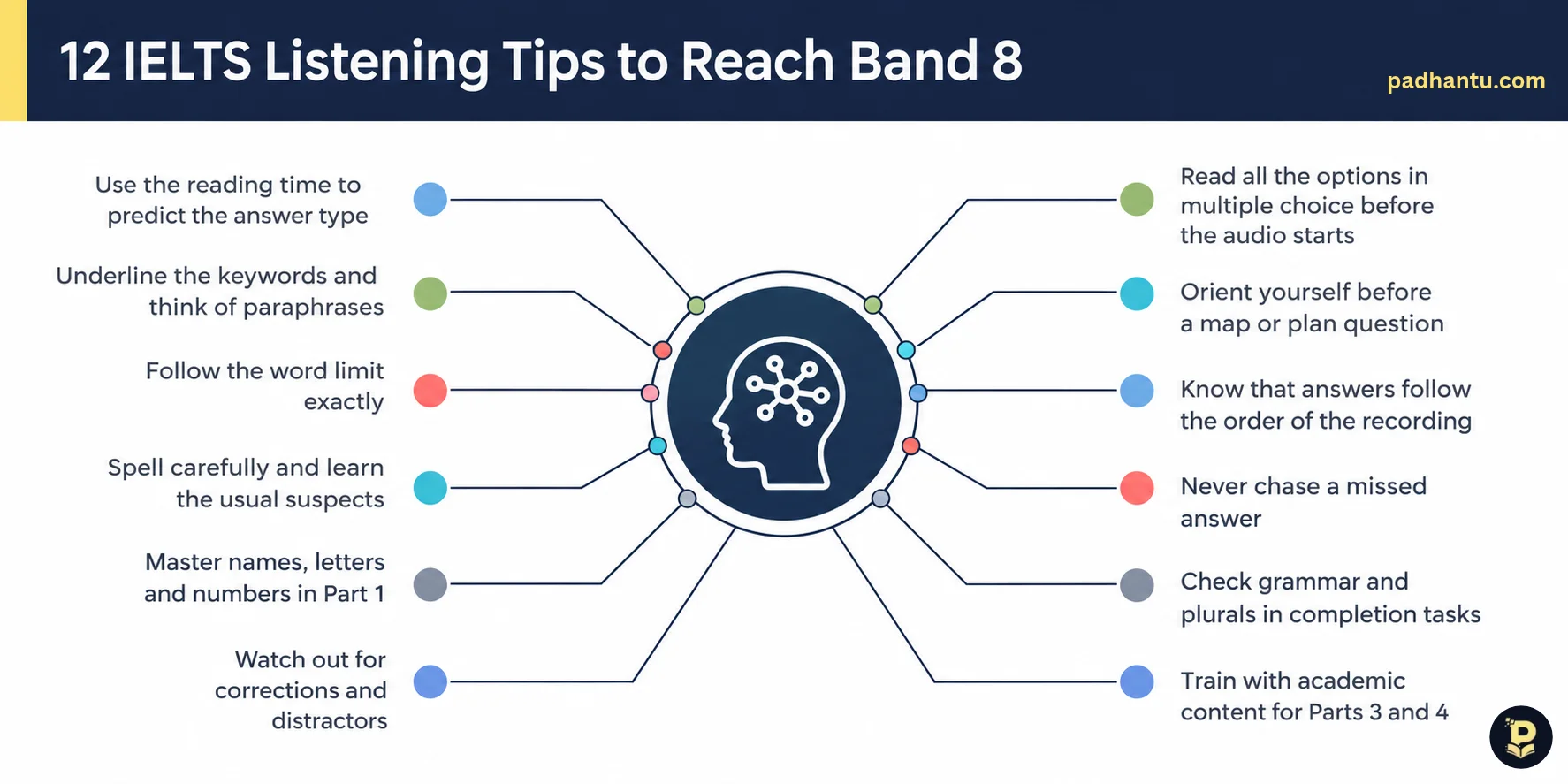
1. Use the reading time to predict the answer type
Before each part you get a short time to look at the questions. Do not just read them. For every gap, decide what kind of answer fits: a number, a date, a name, a noun, a plural noun, an adjective. If the note says "Cost of the course: £____", you are listening for a price. A gap in "Bring a ____ to the first class" needs a noun, probably an object. Prediction tells your brain what to catch.
2. Underline the keywords and think of paraphrases
The speakers rarely use the exact words on the page. When the question says "cheapest option", the recording may say "the one that costs the least" or "the most affordable". Underline two or three keywords per question and quickly think of another way to say them. When you hear the paraphrase, you know the answer is close.
3. Follow the word limit exactly
Instructions such as "Write ONE WORD AND/OR A NUMBER" or "NO MORE THAN TWO WORDS" are strict. With a two-word limit, "a wooden table" is marked wrong even if the meaning is right. Check the instruction at the start of every new set of questions, because the limit can change within the same part.
4. Spell carefully and learn the usual suspects
A misspelled answer is marked wrong. The words that cost students marks again and again are everyday ones: accommodation, environment, government, necessary, restaurant, Wednesday, February, library, questionnaire, and the months and days in general. Keep a personal list of words you have misspelled in practice and review it before every mock.
5. Master names, letters and numbers in Part 1
Part 1 often includes a name or postcode spelled letter by letter, a phone number, or a reference code. Practice the alphabet aloud until you never confuse A, E and I, or G and J. Learn how numbers are said in different ways: "double five" for 55, "oh" for zero, and the difference between "fifteen" and "fifty", which is stressed on the second syllable in "fifteen" and the first in "fifty".
Practice this now: Try a timed IELTS Listening practice test and check which question types and parts are costing you marks.
6. Watch out for corrections and distractors
The recording often gives an answer and then changes it. A caller might say "I'll come on Tuesday, actually no, Thursday is better." The first piece of information is a distractor. Listen for signals such as "actually", "sorry, I mean", "on second thoughts" and "that's changed now". The final, confirmed information is what you write.
7. Read all the options in multiple choice before the audio starts
Multiple choice is where many band 7 students lose marks, because every option is usually mentioned. The speakers may mention option A, then reject it, then agree on option C. Read the options during preparation time, note how they differ, and listen for agreement or disagreement, not just for the word itself.
8. Orient yourself before a map or plan question
Before the audio for a map starts, find the starting point, the entrance, and any compass marks. Notice which labels are already given. Then learn the direction language you will hear: "opposite", "next to", "at the far end", "just past", "to the left of", "in the corner", "clockwise". Follow the speaker with your pencil or finger as they move around the plan.
9. Know that answers follow the order of the recording
In most question sets, answers come in the same order as the questions. Keep your eyes on the current question and the next one. If you hear the answer to question 14, you have missed question 13, so let it go and focus forward.
10. Never chase a missed answer
This is the habit that separates band 7 from band 8. Keep thinking about one missed answer and you will usually miss the next two as well. Make a quick guess or leave a mark, move on, and come back during the review time. One lost mark is a small cost. Three lost marks can cost half a band or more.
11. Check grammar and plurals in completion tasks
In note and sentence completion, your answer must fit the sentence grammatically. If the sentence says "Visitors should bring two ____", the answer must be plural. After "an ____ guide", the answer starts with a vowel sound. Use the short review time at the end to check plurals, singular and plural agreement, and spelling.
12. Train with academic content for Parts 3 and 4
Part 4 is a monologue on an academic topic and the hardest part of IELTS listening. Prepare by listening to short lectures and talks on science, history, environment and psychology for 15 to 20 minutes at a time. Take notes in the same style as the test: short noun phrases, not full sentences. The more familiar you are with academic vocabulary and signposting such as "turning now to", "the main reason is" and "to sum up", the easier Part 4 becomes.
How to Improve IELTS Listening in Two Weeks?: 2-week Listening Improvement Routine
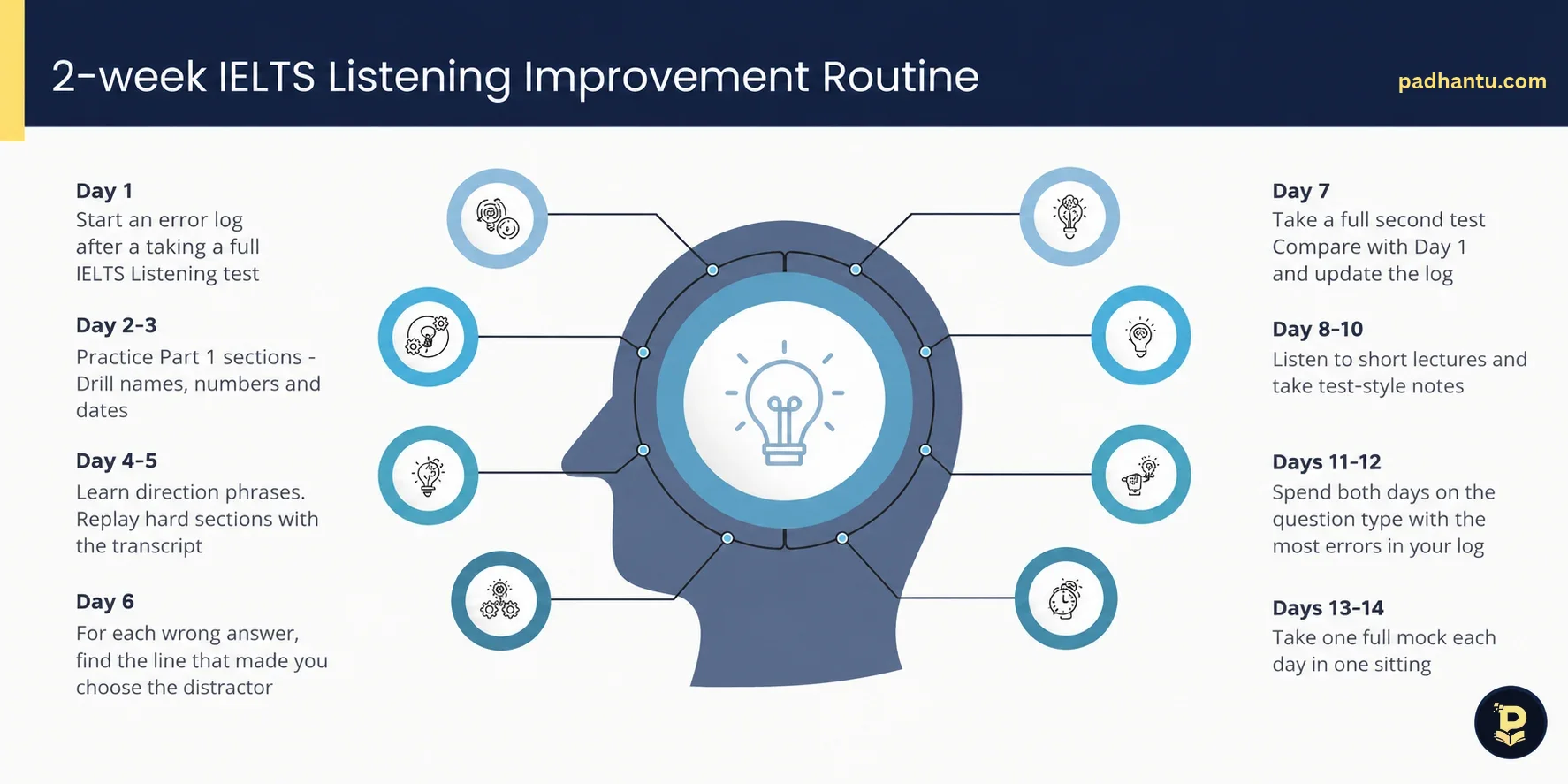
This routine takes about 45 to 60 minutes daily. It is built around active practice and an error log, because simply listening to more audio does not raise your score unless you study your mistakes.
Days | Focus | What to do |
|---|---|---|
Day 1 | Diagnostic | Take one full Listening test under real timing. Mark it, convert to a band, and start an error log. |
Days 2-3 | Part 1 and spelling | Practice Part 1 sections - Drill names, numbers and dates. Write out your spelling list twice. |
Days 4-5 | Maps and Part 2 | Do map and plan labelling tasks. Learn direction phrases. Replay hard sections with the transcript. |
Day 6 | Multiple choice | Do Part 3 multiple choice sets. For each wrong answer, find the line that made you choose the distractor. |
Day 7 | Review | Take a second full test. Compare with Day 1 and update your error log. |
Days 8-10 | Part 4 | Listen to short lectures and take test-style notes. Do Part 4 task with strict word limits. |
Days 11-12 | Weakest type | Spend both days on the question type with the most errors in your log. |
Days 13-14 | Full mocks | Take one full mock each day in one sitting, including Reading straight after, to build attention capacity. |
Your error log should have four columns: question type, what you wrote, the correct answer, and the reason you missed it. Typical reasons are "spelling", "word limit", "distractor", "lost my place" and "did not know the word". After a week you will see a pattern, and that pattern tells you exactly what to fix next.
Tip: when you replay a section with the transcript, read the transcript while listening and underline the exact sentence that contains each answer. This trains you to notice paraphrase in real time.
Common Mistakes that Hold Scores At Band 6 or 7
Reading the questions passively instead of predicting the answer type.
Writing three words when the instruction allows two.
Writing the first number or day you hear instead of the corrected one.
Panicking after a missed answer and losing the next two.
Forgetting the "s" on a plural noun.
Doing practice tests without reviewing the transcript afterwards.
Checked in October 2026 against the official IELTS Listening format page.
Test yourself under real conditions: take a full IELTS mock test so your Listening score is measured in the same sitting as Reading and Writing, just like test day.
Frequently Asked Questions
1. Is the IELTS listening audio played twice?
No, the IELTS Listening recording is played only once.
2. Does spelling matter in IELTS Listening?
Yes. A misspelled answer is marked wrong, even if you clearly heard the right word. Keep a list of everyday words you often misspell and review it before every practice test.
3. How many correct answers do I need for band 8 in IELTS Listening?
You need about 35 correct answers out of 40 for band 8.
4. Is IELTS Listening the same for Academic and General Training?
Yes. Academic and General Training candidates take the same Listening test, with the same four parts, 40 questions and scoring. Only Reading and Writing differ between the two modules.
5. Can I write answers in capital letters for IELTS Listening?
Yes. You can write your answers in capital letters or in lowercase for IELTS listening.
For: IELTS
Written by
Padhantu Team
Builds Padhantu's IELTS practice tests and mock exams. Format, scoring and fee details checked against official IELTS sources (ielts.org, IDP, British Council).
The Padhantu Team builds and maintains the IELTS practice on Padhantu: the Listening, Reading, Writing and Speaking tests, the full mock tests and the band-scored feedback on Writing and Speaking. Our IELTS articles are written and reviewed by the same team. We are not IELTS examiners, so we check every timing, question count, score conversion and fee against official sources such as ielts.org, IDP and the British Council, and update posts when those sources change.